Most everybody who is aware of great change is happening at an accelerated rate everywhere, at least about the inflation and things suddenly going costly and unavailable, especially food and essentials all over the world. Many people, not all, are beginning to realize that this price rise in due to man made reasons. At this point the root cause looses unanimity and great divide seems to show up among people. Also, the state media, the independent media as well as much of social media seem to be on the same side, and point the blame to Russia.
One explanation, or rather, one version of the explanation, comes from an Indian born US politician name SHIVA AYYADURAI, listed below. Have a listen.
He is by no means the only person with an opinion on the root issues that questions the official narrative. but one of many. While he explains his version of why all are behind this subterfuse, he still does not, in me judgement, provide a cline as to why they are dong what they are doing. You get the general impression that they are perhaps into it because of personal again and personal gain only. I find that, while believable, cannot be the whole truth.
নমস্কার, অনেকেই এতদিনে বুঝে গেছেন, যে পৃথিবীতে বিরাট বদল আসছে, এবং অশান্তিের সঙ্গে বিপদও ঘনিয়ে আসছে – বিশ্বব্যাপি দুর্যোগ। যাকে এতদিন স্বাভাবিক মনে করা হত তা এখন অস্বাভাবিক হতে চলেছে এবং যা সমাজে অসম্ভব ধরা হত তাকে যোর করে সমাজে ঢোকানো হচ্ছে, উন্নতির নামে। কিন্তু প্রশ্ন হল – কেন? এর পেছনে কোন শক্তি কাজ করছে? সব মিডিয়া, খবরের কাগজ, এবং সব টিভি চ্যানেল কিছু খুলে বলছেনা, এবং সম্ভবত তারা জানে না এবং জানার চেষ্টাও করছে না।
এটাও কিছু লোকেরা বুঝেছেন বা সন্দেহ করছেন য়ে রাশিয়া এবং ইউক্রেনের যুদ্ধ কোনও ভাবে এর সঙ্গে যুক্ত| এর একটা বিশ্লেষণ পাবেন Dr. SHIVA AYYADURAIN নামক ভারতে জন্ম মার্কিন রাজনীতিবিদের কাছ থেকে – নিচে – দেখুন|
Yesterday I spoke with a number of people from Bengal, India, about the state of affairs in geopolitics and especially about the goobal conflict between the west and the Non-West, as a large iceberg of which the Ukraine conflict is perhaps the very tip. Here is the uncommpressed and unedited lot.
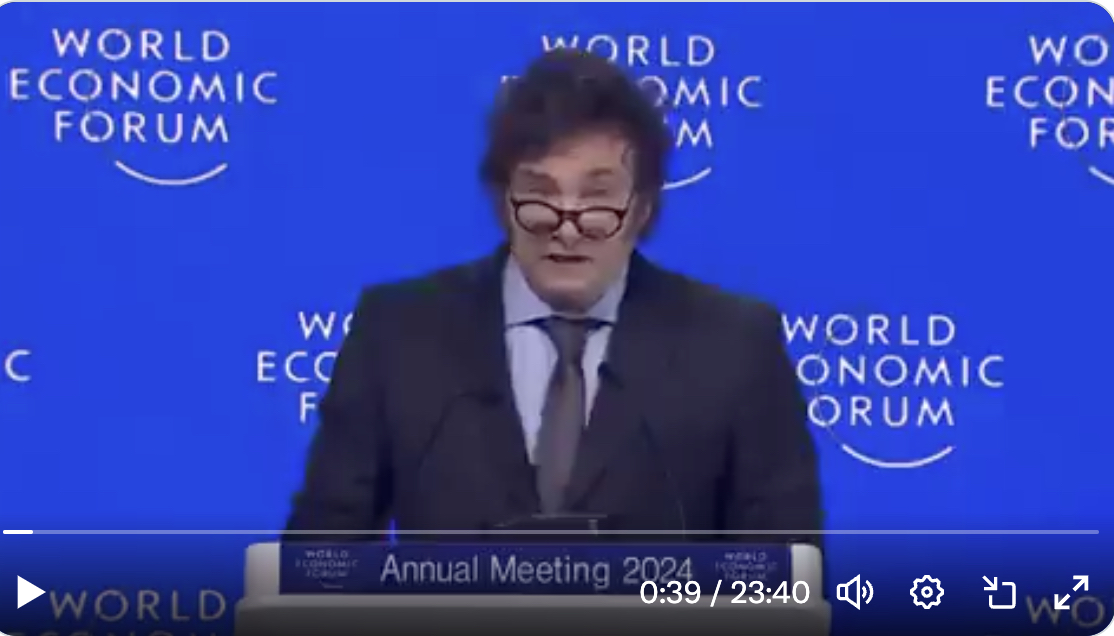
Mr Milei of Argentina was invited to the annual meeting of WEF at Davos this year, a few days ago in 2024. And to oblige the other attendees, he derived a speech. It was a not-so-cleverly out together a speech on the expected lines –
a) How some misguided do gooders are calling for a restriction of unlimited capitalism for the benefit of poorer section of the human population on the planet. Argentina, Mr Milei continues, is an example of how capitalism has elevated the wealth level in Argentina, including the poorer class, which socialism breeds poverty.
Although this is an age-old and often travelled path, I shall try to put a fresh perspective on the topic, stating that both sides of the argument are dead wrong. It is not capitalism or socialism. that is killing the human society along with the earth. It is the misconception, on both sides of the aile, and perpetual growth of any kind is possible on a finite element that is planet earth.
“This is my first post here in a while. The world I knew a few years ago, is gone – never to return. In all my life, I never imagine that the world I knew could unravel so fast, in such a breathtaking speed. Virtually every paradigm that provided stability in this society was about to evaporate.
I knew that the world forests were fast disappearing. I knew nature and wildlife were facing an existential threat, and for a long time. I knew we the planet was going through the sixth mass extinction phase. The first five were doe to geologic events and happened much before humans appeared on earth. In all of them a large portion of living creatures perished in a very short time. The last one brought an end of the age of dinosaurs, and was caused by an asteroid strike on earth. But this sixth one is wholly man made.
I knew all that. And still, when it came, I feel overwhelmed by its suddenness and its omnipresence. There is no escaping it, no corner to hide in. My mind is still grappling with its relative unexpected sudden arrival and its all-encompassing omnipresence.”
First sign for me, was loss of friends
Friends started dropping off. Few of us had the mentality to not take everything that the Medical establishment was saying as gospel and started thinking independently. There is enough evidence that the medical establishment has caused problems in the past. Take Thalidomide, the pill for pregnant women a few decades back. How many children were born with birth defects before the same establishment agreed to pull the drug off the table?
But many of our friends were thinking that way. They left the health issues to the establishment and opposed our views of not wearing a mask or not taking a vaccine. They started thinking we were conspiracy theorists and nut cases.
Then came the relatives. Most painful was the story of my younger brother – younger by nine years. At age 63 he decided to take his first covid jab. I warned him against it. Now that he retured, he should relax and enjoy life. But he was aiming to take on a new job offer as a consultant for a few years, and it required for him to be vaccinated to meet clients. So ie took the shot. Next few days he started having heart problem for the first time. Four days later the doctor said he needs a surgey to bypass some blockage. He was arranging to go to a good hospital, but six days from the shot he suddenly dropped dead, before he could sort out where he should go for the operations etc. Talking to his wife and telling them about the vaccine got her agitated for passing false information to them and they have stopped contact with me.
Then came the other friends. Its the same story always.
Consequently, you learn to keep your sanity and stay mostly by yourself and contemplate the changing world. That is what I mostly do these days.
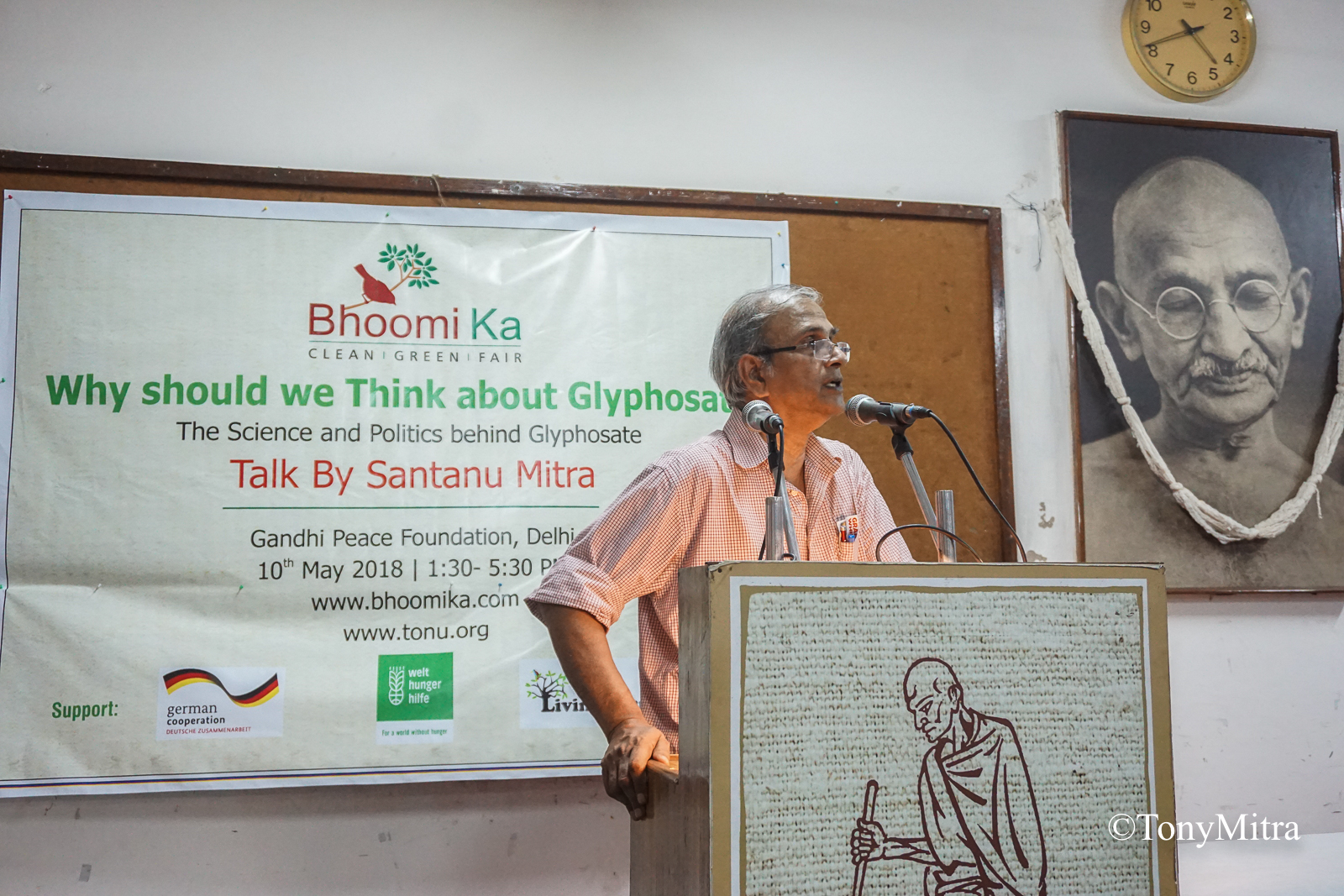
Locals in Canada I had become friendly with are to be divided into categories. The early friends, who became friends on account of my travels across Canada with Shiv Chopra and Thierry Vrain, to talk about Glyphosate and GMOs – how bad they were and what one can do about it. That was the time when I was the only activist in the teams while the other two were kind of scientists with some experience of the industry’s might in controlling government policy to give preference to agro chemicals and not doing sufficient independent tests to prove its safety. It was the new dark ages when science was captured by the industry and profiteering became the new God.
I was only beginning to learn all this, through my link with a few American scientists that were genuinely involved in researching and investigating Glyphosate and its actions in finishing off the living planet. There were, Don Huber, Stefanie Seneff, Anthony Samsel. They were old school and elderly. Today they are old and some of them have retired. They took my call doing the cross Canada trip and told me the answer to what the people were asking from the crowd.
Flashback to 2019 and a Canada-India comparison. Here is a post and a poster from that time.
I am going to india next month for a revisit after a 4 year gap. One reason for the long gap was – vaccine certificate was necessary for flight on a plane. I did not vaccinate and decided travel is less important than my health. Staying decease free and healthy was more important than travelling.
This level of recognition about the ravages of western industry promoted hysteria about covid and near mandatory vaccination as a ploy to destroy the fabrics of human society came upon a small segment of polilation. As a result, I stays in Canada and restricted my travel to what I could achieve in my own car.
Recognition of the root problem is perhaps subdued in Canada. Here people seems to swat at local symptoms and ignore the root cause, which is capture and enslavement of the Government agencies, Science faculties, Agriculture and Medical systems – all by the industry. Profiteering at the expense of human safety, plant safety and animal safety became the new God. You cannot become an honest doctor, scientist, politician, or anything, without sleeping with the Devil first. I know it sounds harsh, but this is self criticism. I am as Canadian today as Indian. It hurts me that in Canada, the struggle seems to dissipate into irrelevance. This hurts.
I understand modern Canada’s history and mindset. It is a vast nation with minuscule population. This makes Canada somewhat unsuited for meaningful people’s movement. India is the opposite.
In India, these factors involving corporate influence in government policy making, too, is real, but the resistance of practicing organic farms and farmers and sections of the middle class have joined in this struggle, thinking independent from the western propaganda, is still on. The battle is ongoing and intensifying, The jury is out.
The world is progressively going nuts. Firstly, the globalists hijacking of society is going on full swing, and has destroyed the social fabric in the west first and actively engaged subverting the rest of the world. Into this group of high power criminals engaged to own the planet, have joined the military industrial complex and Big Pharma. World Health Organization has been captured by Bill Gates for subverting the world of medicine, and the world of agriculture. Most of the major corporations have joined in this – Google being the major miscreant. You cannot search anything without Google and google controls what you can see and what you cannot. Youtube is owned by Google and has removed vital videos and banned some people and restricting others.
But this video is not about them. Bad as they are, a new group seem to have joied them as cheer leaders. These are the Flat-Earth society.
They believe the earth is flat. Not only that, they believe nobody west the the Moon and no spacecraft even went there, and that all is stage managed in a studio. And all the countries agree to this subterfuge. Even India, having a failed landing four ears ago was a stage managed failure and then, four years later all of them again went to Hollywood to stage manage another successful soft landing on South Pole of Moon and again all the worlds government and all science institutions and all media and everybody went along with this story.
And then comes the clincher – they can say what they like on their own wall, I will have no quarrel with that and leave them and their views alone – not my business. But they come to my posts, and lecture me, and continue to argue.
I simply wished to congratulate India for being the first to make a set landing on moon’s South Pole, and got a barrage of comments and sniggers with condescending posts who started what I consider to be an insult to me on my knowledge and told me all that moon landing is bunkum and I have been duped by the system and they did not expect it from me.
I deleted the comments and nos consider that these flat earth’s have become the new menace that are directly adding one more layer of cancel culture, and intruding into my blog.
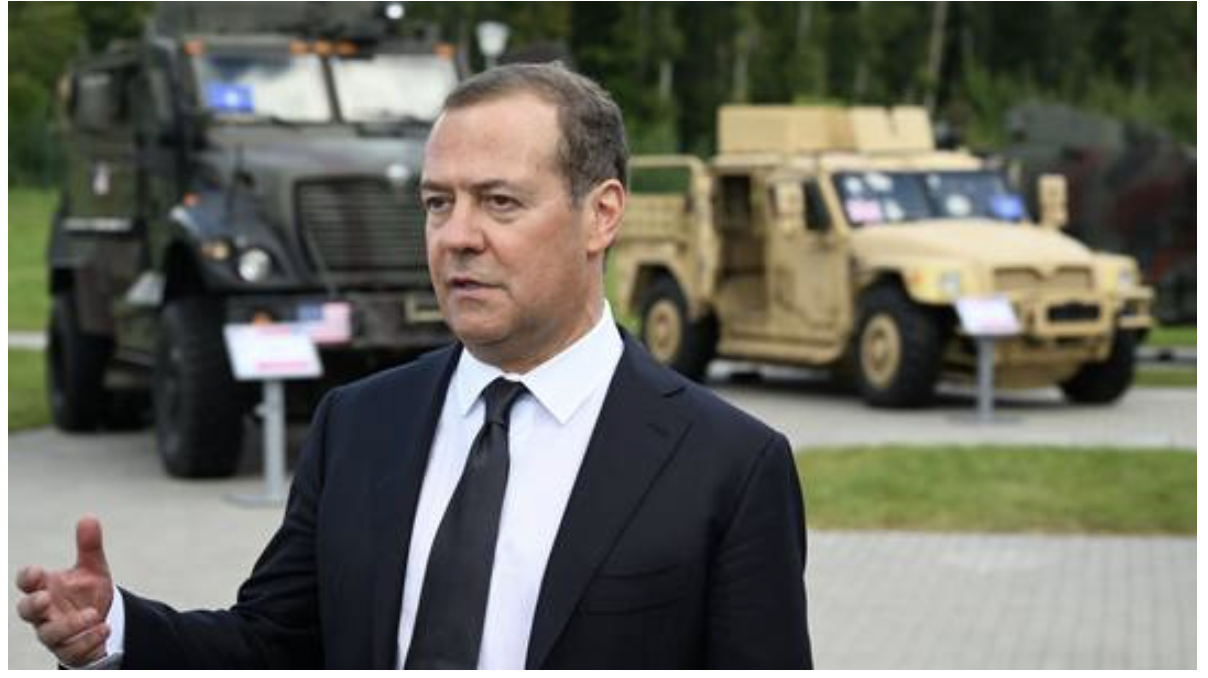
“The collective West is bound to end up defeated by Moscow, the ex-Russian president believes.”
He stated, and I believe it – that Russia through this proxy war of Ukraine poses an existential threat to Russia. Because the real goal behind the proxy war is total and permanent destruction or Russia as a country and the dismember it into multiple fragments and then to loot it.
What Medvedev said, presumably on Telegram in Russian and translated into english by RT, has been described my me in this hastily made video
The world is this last four of five years have changed so much that it is hard to comprehend. Governments were lying to be people time to time and on select issues for political reasons for a long time. We knew that. But the general perception was that the west, and especially the english speaking west was doing a better job that the rest, and that is why the standard of living was higher in those countries than elsewhere. Also they had the size and the resources. This combined with a rule based society where there was little corruption – made them a dream country compared to others, for potential immigrants the world over.
But now, that facade is crumpled and the ugly inside has not only been exposed, but is being flaunted openly as a great achievement. There is no freedom of speech, no accountability and the high lifestyle is fast deteriorating. Life looks like a train wreck breathing down on us.
I have never learned how to couch my words and do not want to do so now. Western civilization is finished and imploding upon itself, Globalists and dirty politicians are acting as maggots trying to eat the society alive like they do to dead carcass.
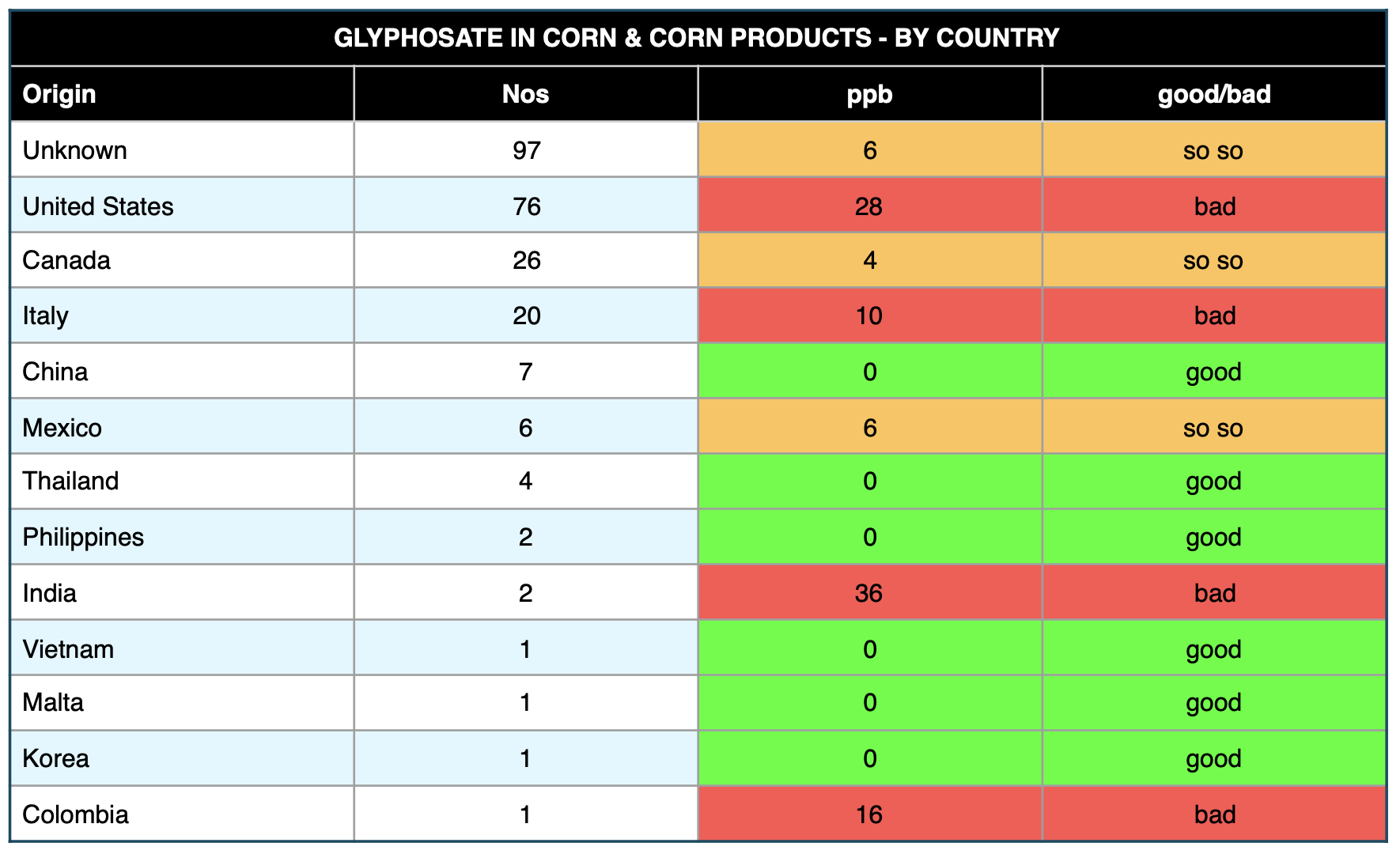
My book POISON FOODS OF NORTH AMERICA, with the data is now 7 years old. Things have not stayed static during this time. Usage of glyphosate has increased all across the planet. Science if now wholly a property of corporate agro-industry and big Pharma for profiteering. Public does not fund it and does guide it or own it.
You pay junk money for science, and you get junk science.
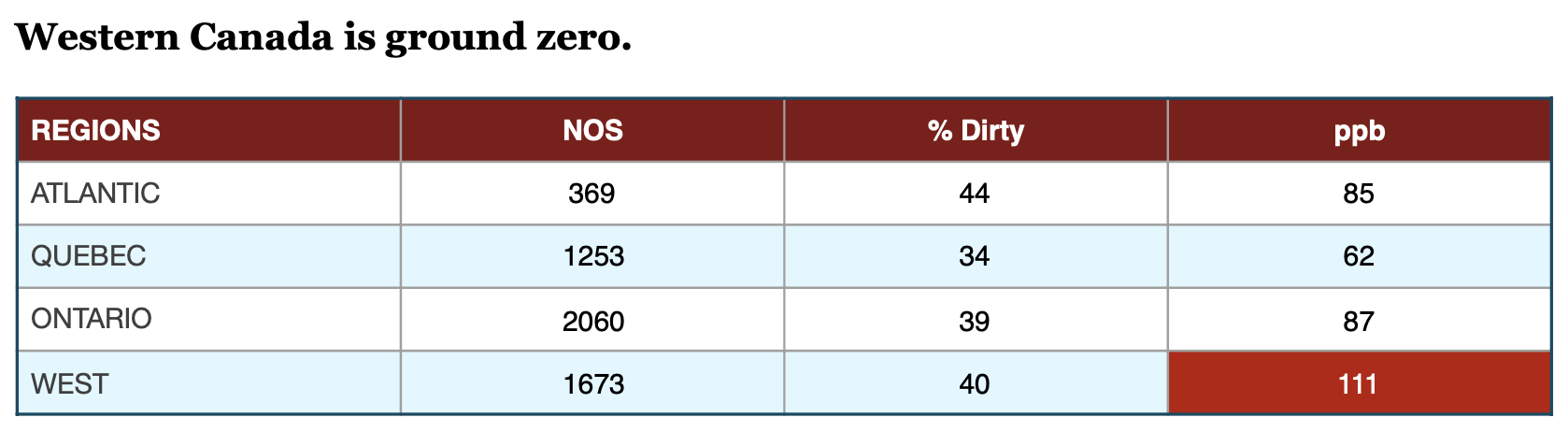
That is the sad story of the world today. Then on top of that we know have the cancel culture, woke culture supported by state approved misinformation and lies. Social media too has joined in. Night is projected as day and vice versa. Back to my book. The table below is from the book, with a breakup of the regions in Canada and how toxic the foods are on average in those regions – with respect to glyphosate, the 900 pound gorilla at out dinner table. The regions are chosen and categorized by CFIA (Canadian Food Inspection Agency) under Health Canada. And the data they sent me is shown as originating from those locations.
That indicates the west of Canada is the worst place to be in Canada when it comes to food. And since Canadian food is arguably slightly more toxic that US food, and together North American food (sans Mexico) produces the most toxic of foods in the entire planet, western Canada can be shown as the global epicentre of toxic foods.
But this story is slightly misleading. All the provinces of Canada west of Ontario has been lumped together in “west”. However, there is a great geographic, geologic, topographic and agricultural difference in the region when it comes to agriculture and usage of glyphosate. British Columbia stands out separate from the other “Western” provinces. It has various mountains ranges like the cascade mountains and the rocky mountains.. Agriculture is largely conducted in the river valley and not so much elsewhere. Also, large flatlands as mostly absent here. As a result giant farms of 20,000 or 30,000 acres under one controlling ownership engaging in industrial scale farming with huge input from industrial chemical is missing here.
But the same British Columbia is lumped with Alberta, Saskatchewan and Manitoba, or the so called prairies. These consist of massive flatlands that do engage is super scale industrial agriculture with massive doses of chemicals sprayed by air planes.
The prairies are the epicentre, the real ground zero of toxicity on planet earth.
And here is another table from the same book, with data that is seven ears old.
glyphosate in cereals
Started working on my book, modifying to a new version.
Going over the data on corn, I have given up on sweet corn from Canada, India and many other countries too. The data is 7 years old, but the use of glyphosate in increasing everywhere.
There is a need for more testing, but nobody is able to get their government to test foods for glyphosate. I am going to be asking Indian organizations to firstly increase lobbying to test food for glyphosate and also consider starting a movement towards that, and lastly, to start testing small sample os food for glyphosate by different groups and collate the data.
When this book was published, data on Canadian corn was better than the US corn. But i suspect the use of glyphosate in Canadian corn has increased, It tasted bad, and the quality was degraded. I have been the only exception getting Canada to do the extensive testing. But that data is 7 odd years old.
Private testing needs a lot of money. I am retired, so cannot afford large sample testing, but I can test one of two samples in Canada. Anybody wants to join me?
Anyway, my focus of now on India as I am scheduled to visit there in winter, and because the book if due to be revised.
Attached table from my book – Poison Foods and North America.
Note, data on Oats was missing on the original book and will be added in the revision. Reading are shocking – The MRL levels are these are 35,000 parts per billion, far more than any other cereal I can find. I know health Canada increases the safety limit of glyphosate on specific foods not because it has found evidence of no hard dome to the living world though increase dose of glyphosate but rather, because the old safe limit has already been crossed per the lasted acquired data. 35,000 PPB – Jesus. H. Chist. Thankfully, I don’t eat oats. I suspect most of it is goes in animal feed. Poor animals cannot complain when they get cancer in middle age.
Life is changing so fast here is most of the western nations that it has gotten difficult to keep track of all, except for the “Woke” crowd. A major problem is the state propaganda here, and the main stream media not covering any of it because they are dependent on state subsidy which obliges them to portray what is acceptable and what is not.
The geopolitical shift and the changing of global balance of power is happening right now which, according to experts is going to crash all the fiat currencies in the world. The only ones that might survive appear to be Russian ruble and the mechanism that is supposedly being put in place by the BRICS+ nations with a commodity backed currency. I am not sure exactly how that will work except for the Russian ruble.
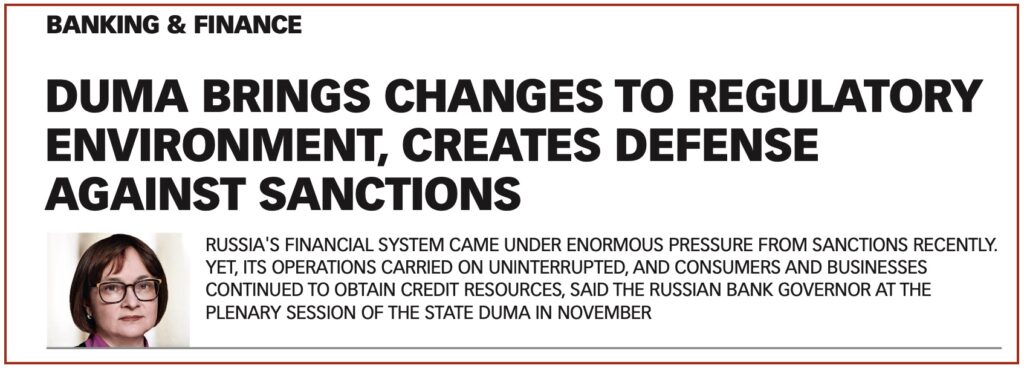
Russia is already more or less out of the petrodollar based fiat system due to sanctions and having been kicked out of the swift etc. It has survived thanks to safeguards it started putting in its finances many years ago, including internet. I do not know enough of what the Chinese have done because they are straddling both systems. But the Yuan with some sort of multi commodity backed multi currency is being worked on its way The third country is India, which to me is very similar to China in the sense that it has its attachment with the fiat because of extensive trade with usa as well as Indian born diaspora earning in dollars and the pro-US bias by the Westernised half of the population, and same time its wish to be non-aligned and be able to trade outside of the western circle. America has set two different kinds of target on China and India, for refusing to stay within the petrodollar world.
I feel convinced now that the root issues behind the Ukraine war is the key to decide if the west (meaning the US followed by its satellites like Canada, Australia, Europe will survive unscathed or we are seeing the inexorable decline of the west – to be replaced by yet poorly defined Multi-polar system.
The Saudi-Iran realignment is a watershed event for the oil bearing middle east. It is geared to move the entire middle east away from US manipulations. And this detente happened, for the first time, by Chinese mediation and USA was not even invited into the discussion. This is a geopolitical bombshell. It is hard to imagine how the US will react. Saudis have already started selling their oil in currencies other than the dollar. It is hared to imagine the petrodollar will survive. And if it does not, then all other currencies and banking systems linked to it, including the world bank and the IMF may go and the currencies other than the ruble may collapse, at least partially. CBDC (central bank digital currency) might become a reality in most of the world.
For many of these reasons I had been focussing more on getting the news from within Russia, and having a real hard time getting through to the educated people there. I did not know Russia has so man layers and half of them are controlled, at least up to a point, by the US directly of indirectly. This is why the US can whisper about Regime change and/or assassination of Putin.
Russians know about that, but the reaction is not uniform. The urban english speaking population has a powerful section that is anti-Putin. They are in the academia, Judiciary, Parlament, Banking and NGOs. Furthermore, the Russian constitution was created with American help where they cleverly inserted clauses that prevent Russia for doing what is in their vital interest against US or outsider control. In 20 years of post Yeltsin control by Putin, he has not been able to remove the most difficult clauses within its constitution, like article 13, 15 and 75, despite trying a few times already.
But overall, Putin has over 80% public support and realization is dawning among the people that Russia cannot afford to lose the Ukraine war, because if they lose, there will be no Russia.
Meanwhile, the west has seriously underestimated Russian resilience in all spheres. It considered Russian economy to be seriously degraded – which was correct at the turn of the century, year 1999-2000. But the impressive revival of its industry, education, agriculture, science and technology has gone largely under the radar of the west. Only because of the Ukraine war that the west is discovering that the Russia Ruble an economy is insulated from the west and cannot be hurt by Sanctions. It is finding out that Russian science and technology in many sphere has leapfrogged the west. And Russia is not just a gas station – It has become the biggest food exporter in the world etc etc.
I am beginning to realize that the reason the western institutions so grossly underestimated Russia is because the western method for calculating stuff like economy, GDP, science, military status – all are based on fake speculations and theories. And thus, the US initiated a war it now cannot back out from and cannot win. Cannot back out because Russia for many reasons has gotten to hold maximum resources that the west must control in order to maintain its hegemony. And this is a war the west cannot win because it depended on faulty assumptions of Russia’s preparedness to withstand US sponsored proxy war between Russia and NATO through Ukraine.
And the silent revolution has started in Russia, where the anti-Putin elements are slowly being weeded out.
The biggest benefit for me has been discovering the Vedic link between India and southern Russia – going to a phase of Vaishnavite movement linked with Vishnu and his avatar Krishna, and the common roots of old Russian language with early Sanskrit. I had learned about the India-European language group linking Indian and west European languages, but the slavic languages were excluded from the group by western linguists two hundred years ago. Now I suspect this happened through an anti-Slavic bias by the western European linguists of the time.
Arrival of orthodox Christianity around 1000 AD complicated the story because, like the Muslims, the early Christians were engaged in destroying temples, and scrips. Only now, some of it is being rediscovered.
I came to know a few Russians that are practicing or experimenting this path again – mostly through a revival of the ISKON movement. They are more forthcoming to me regarding what is happening inside Russia today with regard to resisting US hegemony on one side, and promoting a multipolar world on the other.
These are keeping me pre-occupied because all of this is outside of much of the media. Even in India, only a small section is engaged in it, hut superficially according to me. The Governemnt, if they are aware and I suspect some key segments of it is aware, but they are not talking about it. And the media is, while diverse, completely out of it, and the public are, like in the rest of the world, exposed only to the western version of the goings on.
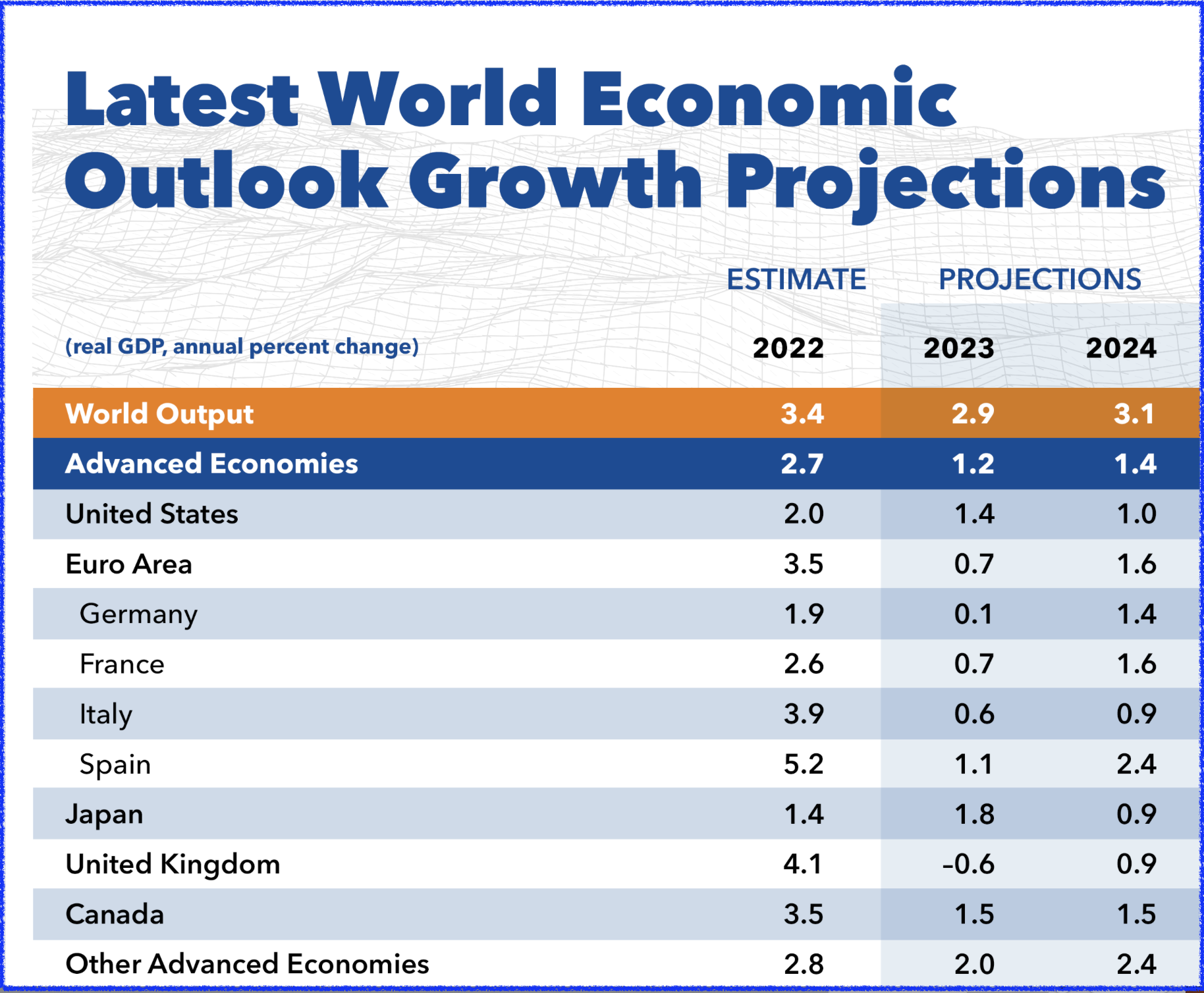
IMF has listed the global winners and losers on the economic ladder for 2022 and same time predicted the position of the major players for 2023 and 2024.
But I have a reason to seriously question IMF’s ability, or honesty in such predictions. And yes, the war against Russia has lots to do with it.
But first, let us check what the report says. It says advanced countries had a growth of 2.7% in 2022, which will fall to 1.2% this year and creep up to 1.4% next year. BRaking that down, it predicts the figures for the US are 2.0, 1.4 & 1.0. I have many reasons to seriously doubt such estimates. Everybody knows US GDP on purchasing power actually shrank last year and did not at all grow 2%. It however predicts an actual shrinkage of the British economy in 2023. But surprisingly, most European economies will continue to rise, though just barely above zero.
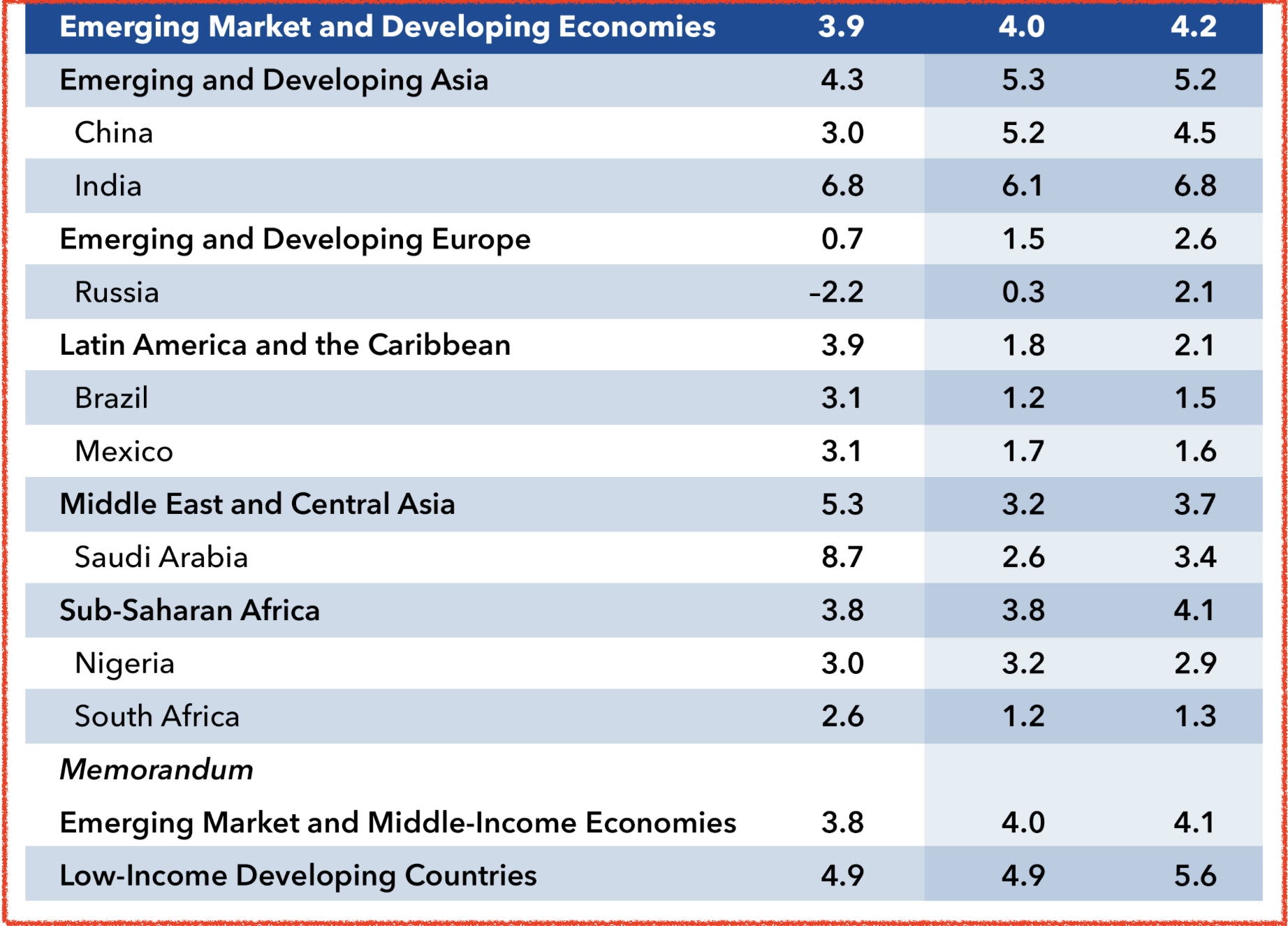
Then comes the so called developing nations. Earlier they used to call the rest as backward nations, but the west has learned to be more polite these days. China, considered as the most powerful economy in the world today, outpacing the Americans, are slotted within this developing group.
Check China, the largest economy today. It’s growth is reported to have been 3% last year, but expected to jump to 5.2 this year. Among the large economies, India seems to be the shining example in this report, and much talked about due to its contribution within BRICS+ and the collective clout of this group agaisnt the developped group. Along with them, there are more potential BRICS+ joiners that are also star performers – Saudi Arabia, Middle East & Central Asia.
Note – Russia is missing here.
It has taken me a long time to figure out that rankings, past statistics and future predictions of economic activity of nations around the world, projected by mostly renowned western intitutions, are tainted and in some cases, fraudulent, to give the wrong impression to readers, say about promoting Russophobia.
This is not unlike how Facebook, Google search, YouTube, the US Government, and mostly all media channels also project the news heavily biased to suit agendas of the folks that own or control these institutions.
Of recent – I have spent time and effort to dig into Russia, to figure out how a country, Russia, can not only fight off the collective might of the entire western nations plus a few non-westerns (e.g. Japan), if Russia’s Economy was less than a twentieth of the collective West+. To me, modern warfare is highly dependent on the economic, industrial, resource base & scientific details of the parties engaged.
On paper, the collective west has more than twenty times the economy, and incalculably high amount of financial, legal, social, and industrial capacity. Russia has often been described dismissively as a country that is little more than a gas station, ruled by a despotic dictator.
If the economic forecast, and calculations of industrial base are correct, then, considering the attack on all fronts, military, economic and everything else, directed agaisnt Russia by USA/NATO, then Russia should have been dismembered, sliced and gobbled up within a month of the beginnign of hostilities.
But the way it looks, the collective west is fallling on its face.
To me, this is a very strong indication that the western projection of most all data, economic included, is fradulent and has been misinforming the people about facts and misleading them down the wrong path.
Russian economy, after the Yeltsin induced free fall, was considered to be ranked way below the top ten and somewhere at par with perhaps Spain. I know in my guts thats a lie, because Russia is able to shrug off near total sanction by the entire west, and is able to outproduce the west in military hardware, and able to invesnt, design and produce deadlier weaponry, staying ahead of the west, and its currency is strengthening instead of weaking.
This tells me two things:
1) Russian economy, science and industrial base are far stronger than projected.
2) The economic predictions by the western financial institutions are crap.
I have mulled into the reports, as a marine engineer and not as an economist, which I am not, I have actually placed a lot of data in my own giant spreadsheets to check how they look if I try to projust something taking into account various factors within my own knowledge and hunch.
PricewaterhouseCooper International is an intriguing source. It is a vast network of accountancy firms spread across the globle, that provides assurance, tax and advisory services. They are everywhere, including India. They make their own predictions, and some of it is interesting, and often different in the message they send out, compared to the US Govt, the World Bank or the IMF, or what you might read in Financial Times.
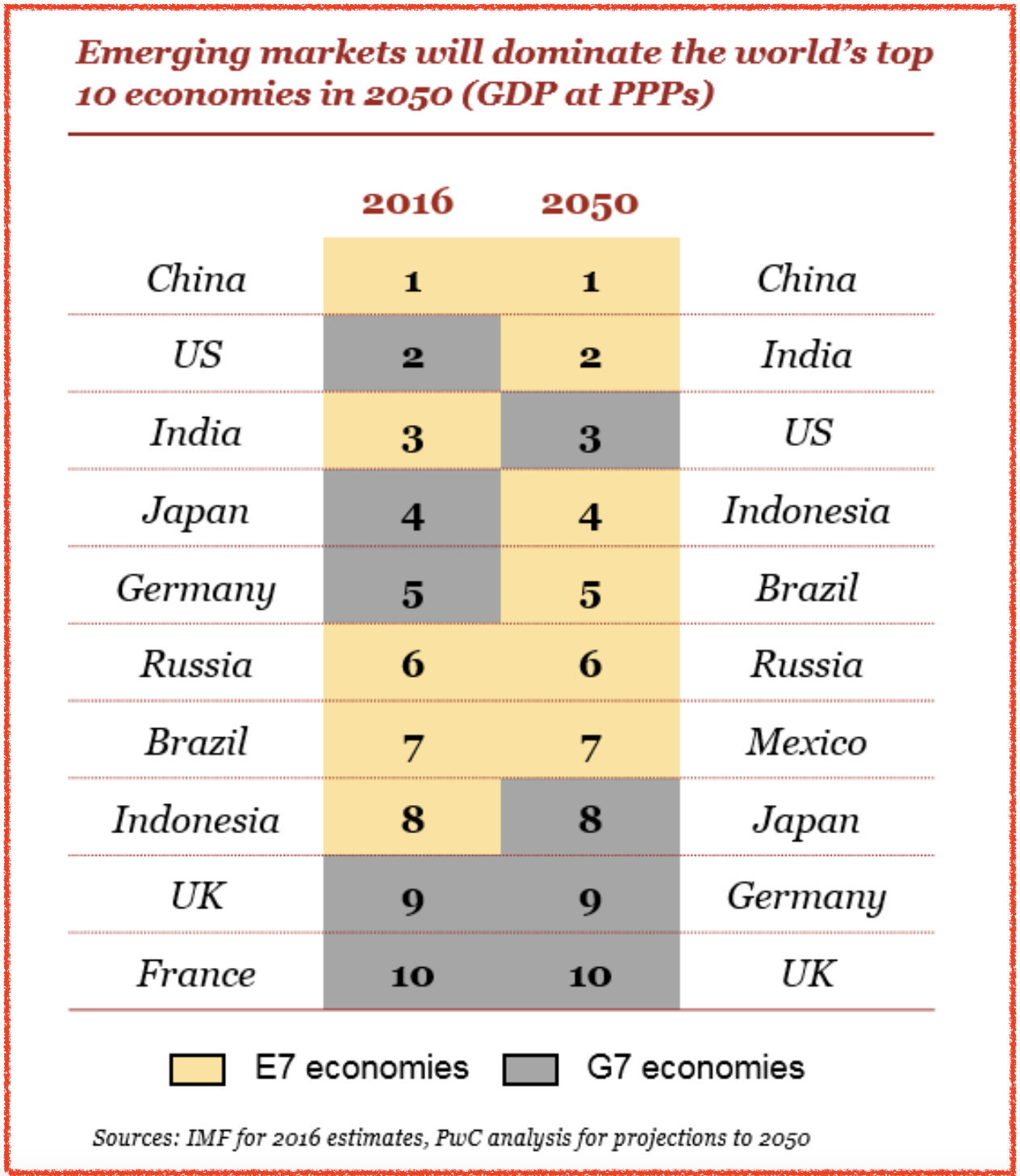
The attached chart is from this network of accountancy firms. If you see their 2016 data, the so called emerging economies already carry more punch than the so called advanced nations (G7 versus E7). You did not know about it because G7 is an established group that meet every year and take collective decisions. E7 did not up to recently. They do not even identify themselves as E7. But much of that is now changing, thanks to BRICS+, and the Ukraine conflict and US hegemony.
Thus, the Ukraine conflict has been a massive game changer that is threatening to shred the existing world order as well as Klaus Schwab’s GEF based plans of a new kind of world order.
By 2050, it looks like game over for the west. Six out of seven top econolies will be non western, the US being the only exception. Indonesia, who nobody hears about, will be the 4th largest economy in the world.
But what about Russia? Well, PWC is also a western network. Somehow, their study is likely based on western projections. Even then, Russia is present, at 6th place in both columns. This too, I suspect, is biased and wrong.
I have heard some Dutch experts comment that Russian Economic and Industrial might is not understood well by the west and they are now highly biased against Russia, hence the projections show them absurdly lower than others. I think he was speaking the truth.
WIthout being an economist (thank heavens), I suspect the Russian industrial/scientific/economic acumen, combined with their near inexhaustible richness in resources like energy, food, and gold, their actual ranking should place them between 3rd and 4th today. I cannot predict 2050 since it is too far away.
Then, considering the top Emerging nations – E7, is already stronger than the G7, and are mostly aligned behind Russia in this Ukraine conflict, I cannot help but suspect that the combined West might be facing a long term sunset scenario. The only direction open for them is sliding downhill. Unfortunately, USA exerts a near iron grip on the groups outlook and activity. So USA is likely to drag the rest of the west along with them.
IF we do not have a nuclear holocaust, or a financial meltdown with GEF initiated digital currency surveillance world, which the non-West are possibly likely to reject sooner or later, once they get their act together – I think it may be game over and a reverse migration era will start. People of the west will try to learn Mandarin, Hindi, and Russian, and hope to get a job away from home, much like many Europeans for two hundred years, took all their belongings and hopped a ship heading for New York.
I am still mulling how to connect these dots. But I am already guessing that Russia is at the fulcrum. It is neither eastern nor western. It is Euratian. It appears close to west, but is anchored in Asia. Russia is, in my thinking, likely to be the largest swing state.
Apart from Russia being at the fulcrum, there are more things to connect the dots. Example:
The coming collapse of not just the US dollar, but the entire banking system, where we are to see out money in baks dsappearing or being inacessible. There ill be bank runs across the planet. A new kind of mandemic is to be declared globally – the cyber pandemic, and everybody will be subject to severe control on expenditure.
Russia will be blamed for the pandemic, although Russia will have nothing to do with it and the crisis was either organic, since the banking was going to collapse on its own weight for creating too much fake money.
BRICS+ is seriously chaning the global balance of power. Ukraine and its importance, along with NATO, are all going to be less important.
US acknowdges defeat in Ukraine and stops funding it, and begins to pour money into Indo-pacific region to bolster AUstralian naval power to challenge, along with the US and UK the new global enemy – China.
Biden is asked to step down due to corruption charges. Kamala Harris becomes the short term president. She has no chance to win any election on her own, so the Democrats will not nominate her to lead the party in the next election, making her a lame duck with nothing to lose. She will, therefore, declare tha the US is pulling out of Ukraine, essentially conceding defeat.
New shift to Indo-Pacific under new alliance called AUKUS (Astralia+UK+US) will also mean US funding for new nuclear.subs and weaponry to be given to Australia will need huge funds, so Europe/NATO/Ukraine will stop receiving funds. This is the death knell for both Ukraine and Europe.
Role of India not properly undestood – this has remained under the radar till now. But world’s focus eventually will turn here. Will India compete with Russia for for the top spot as the Swing State. Indian Govt is tight lipped but appears to be very sane, level headed and not inclined to brag about whats going on. Watch India.
This is a carry over from my previous post, on connecting dots.
They say, writers get writer’s block, where they go into a phase when they cannot seem to write even a sentence. Well, I am not a professional writer, thankfully. But I often get into the opposite of a writers block. Too many different ideas, opinions and views crowd into me when I start writig. They jostle with eath other for my attention. One wants me to move this way, and write up about this issue. Another tugs me the oppsite way, reminding me not to ignore something else. I am being pulled in many directions to write about many different things that, together, helps connect the dots. Was I always like this? I know I was always full of questions and used to drive everybody nuts. Anyhow, now that I am busy connecting the dots, too many views crowd into my head and I try the filter through them to chose what I would write first and what next. In the process I end up explaining myself and my life as part of the story. Perhaps my life can help explain why I think the way I do. And by my life, I mean both the place and time that influenced my growing years, and the genes that I share with my parents and my siblings. Both my siblings – my younger brother and my elder sister, are no more. I am all alone on earth right now. But the urge to write continues … since this is such a complex world today, with so many dots moving in so many directions in so many different speeds in three dimension. My writers anti-block keeps pulling me differnt ways. Some of them pulls me to analyse how I grew up to be influenced by how many different things in how many ways, to have a mind set that makes me want to connect the current dots and to make sense. I never before had this feeling that the world is moving ever faster towards a combination of multiple kinds of doom.
Am I going nuts as a sign of senility creeping up or is this rational thinking that the world as we know it is going to vanish suddenly and that 21st century doomsday is nearly upon us, hanging like the sword of Damocles? I know the world medical ssytem has been working for multiple generatiosn now, slowly, to begin a system to make kankind sick for their entire lives, so everyone is a lifelong customer for the medical idustry. I know the new age moden agriculture is likewise trying to make agriculture dependent on acrocorporation products that makes our food sick, so we are permanently dependent on these industriess in order to eat. So our food and our health, has already been captured. What else is left. Well, there is about wealth. And finally, there is the planet, with everything on it. Am I delusional or am I being rational? I have the data to claim most of my suspicions.
But let us first go back to how I grew up, as one of the factors that influence my dot-plotting.
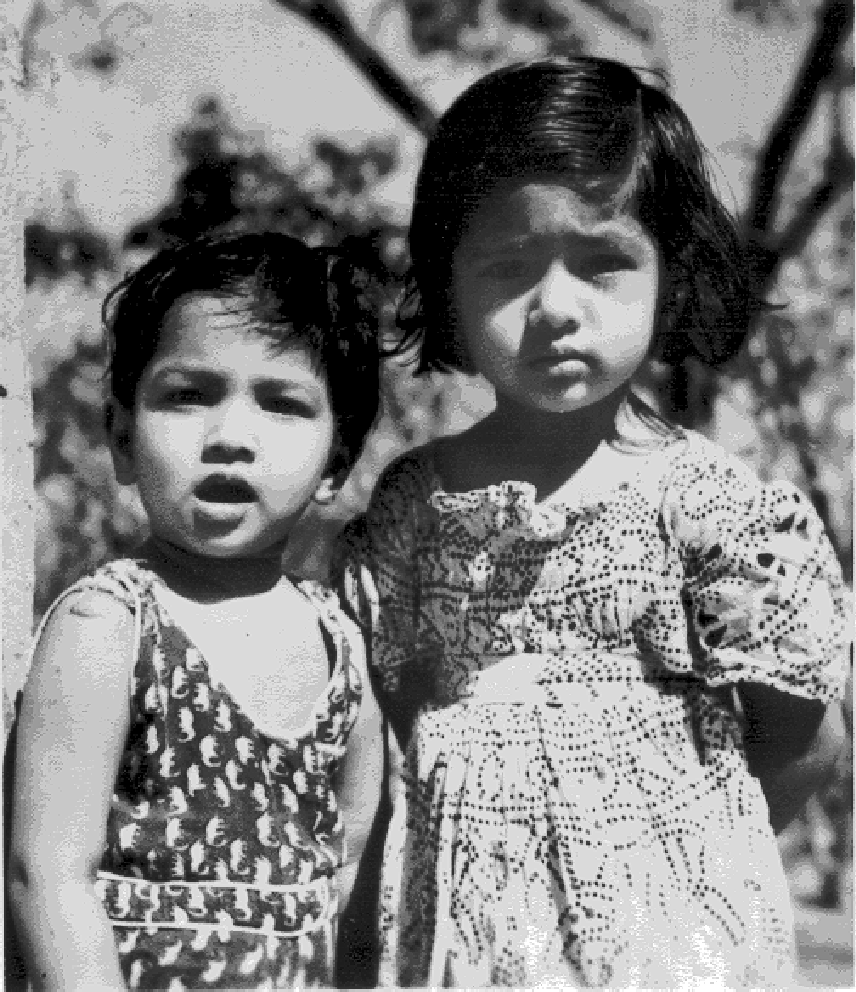
Thats me, two years old, and my year older sister. Far as I know, this is my earliest picture that has survived. My opinion and world view started being formed from this time.
Back to Facebook.
Odd as it may sound, I am now looking back at my life and same time being pulled towards toying with the idea of comparing our 22nd century mega social giants, such as Facebook and Google, as Black holes in our society and our subconscious. They are physically invisible, and yet, they are like an invisible parallel world that have gotten inside our psyche, and playing with our brains to shape the way we think. They are way more powerful than any drug or pill or jab invented by Big Pharma and they are eating our humanity from inside out.
It is a supergiant thingamajig that you can never see nor photograph nor visit, but is so huge that it literally bends, curves and convolutes the space around it and in a way defines our universe. Whether we can identify it, or not, is the thing. Today, I have come to the cross road where I wonder how my life’s journey took me from village India, to Facebook and how I now toy with the idea of comparing it with a Black Hole. But, how are we influenced by our movement through flow of the stream that we call life on earth?
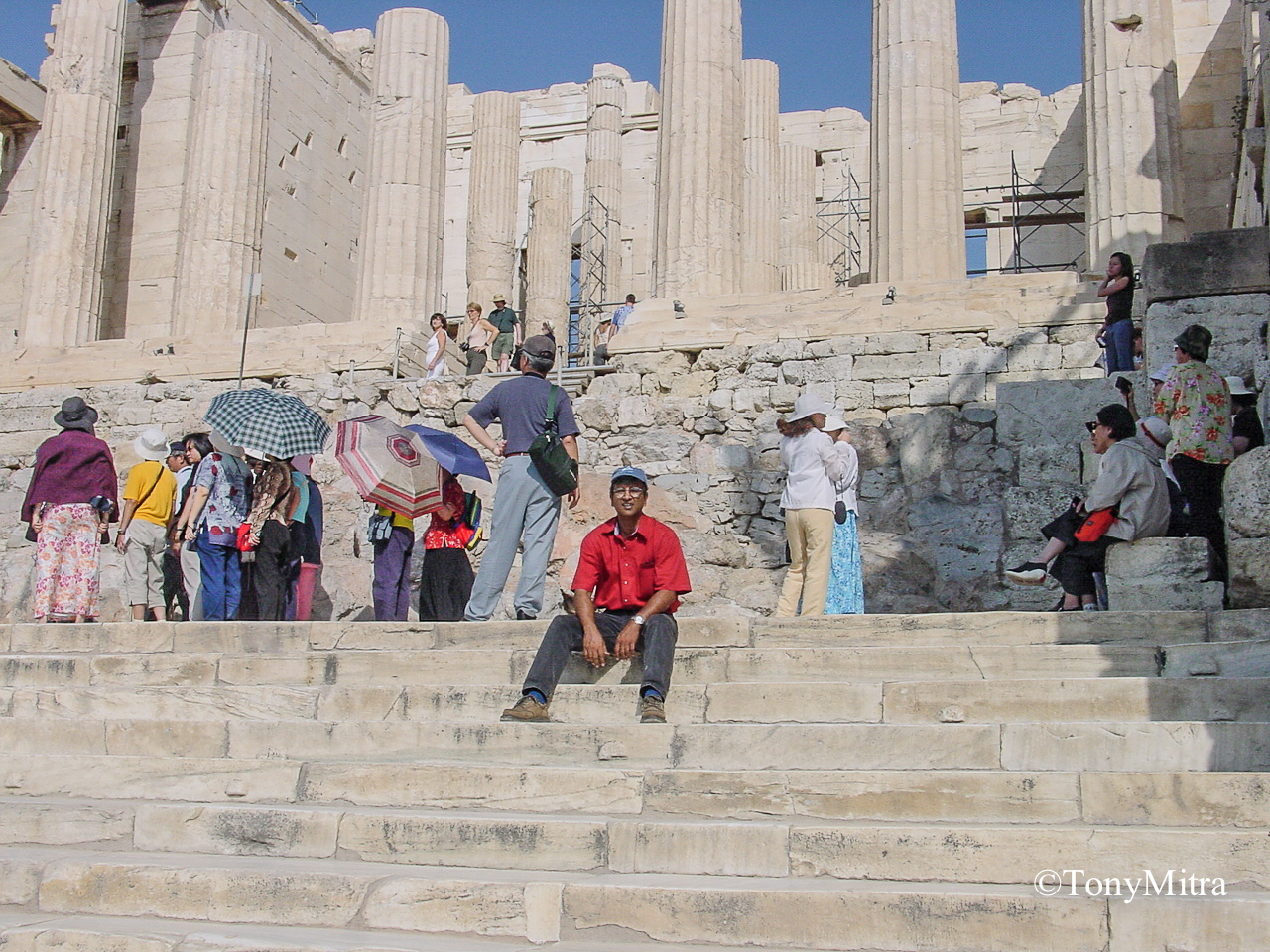
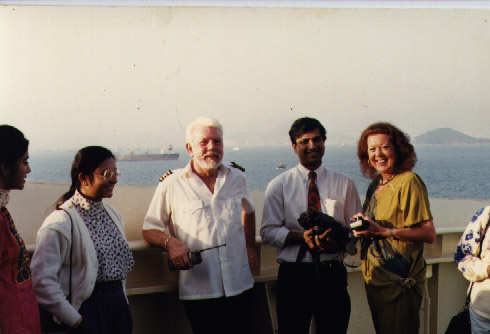
Self went to inspect a ship in Hong Kong harbour in the 1990s,. I am standing between the British Captain and his wife. The captain was a friend, who asked me to bring my wife alone, so I did. She is standing next to the captain.
From those days and even earlier, from books we read, village drama we see at night on stage, or the chanting of religious or seasonal festivals – we have always been influeced by what we see and hear, to form out public opinion.
Public perception of life was being controlled by private enterprise for a while. Two generations ago, people use to say about Hollywood – There is no business like show business.
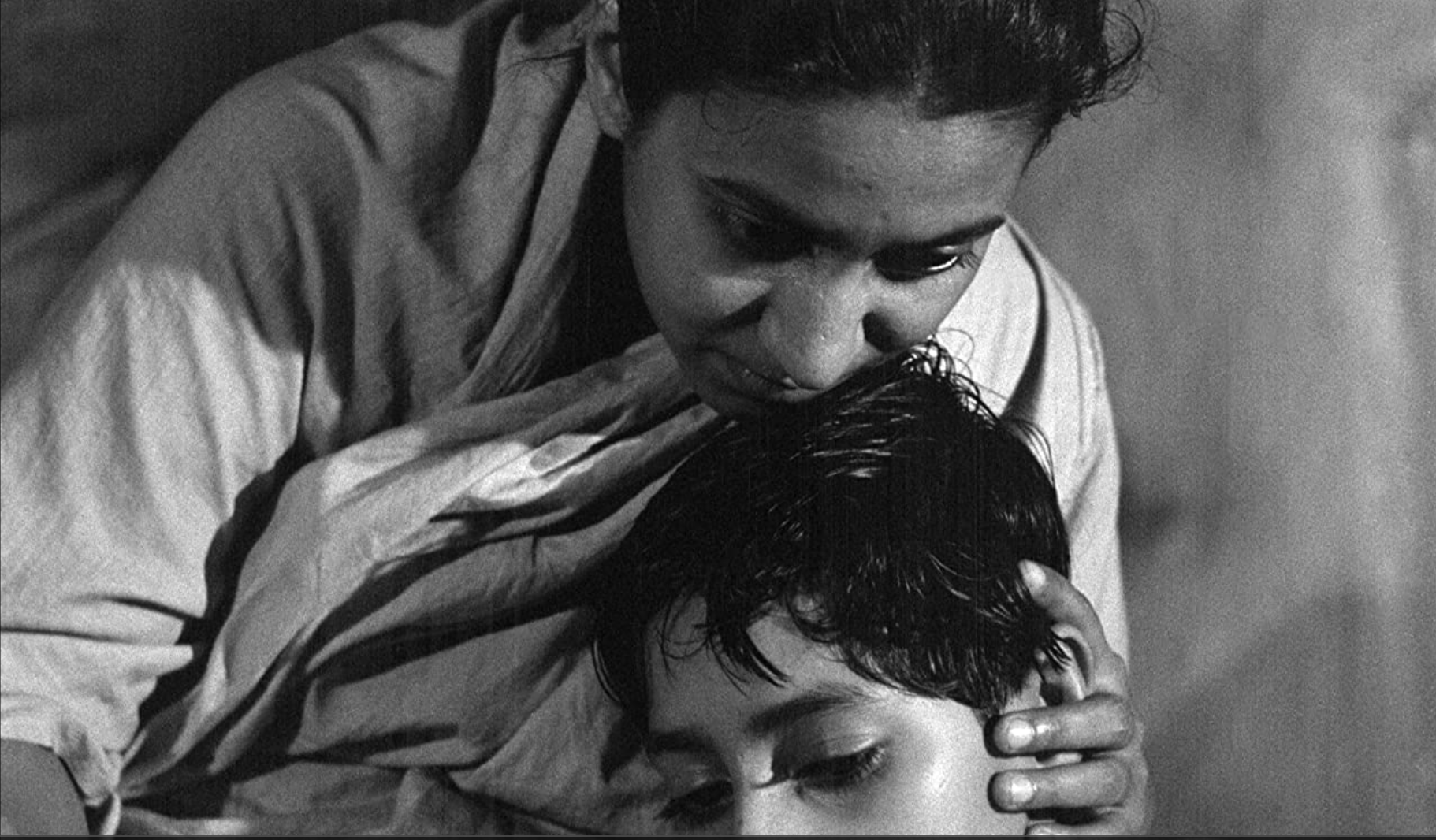
I remember the the details of first movie that I saw, in Kolkata, India, with my mother. It was a bengali movie, the title would translate as “Song of the road”. It was from 1955. It got a whole slew of national and international rewards and literally launched Indian cinema on the world stage, winning award after award across the planet, except in Hollywood. But decades later, its director, Satyajit Ray, in his last days on his death bed, earned a long distance lifetime achievement award by American motion picture award ceremony in Hollywood. The picture was a tale of the views around his world from the eyes of a very young kid, barely five or six year old, living in a very small village in an abjedtly poor (in comparison with the rest of the world) rural family. The family was leaving their ancestral village since they lost their mudhouse home. All their belongings were packed, occupying half of a single small bullock cart. The other half was the sleeping quarter for the father, mother and the boy. They finally came along a railway track. The boy had never seen a rail line or a train. He vividly recalls his dead elder sister, who had once asked if someone could please take her to see a train.
The movie – Song of the Road, in Bengali, was the first movie that I remember seeing, possibly at the age of six, that my mother took me to see. This movie left a vivid effect on it, till today.
Even today, as I remember how my mother held my hand and took me to the cinema hall, and how I gawked at the giant screen as the movie played out. I was myself perhaps six years old. I am now going to be 73 in a few months. Even today, the memory of it raises the hairs in my arms, the experience was so vivid and touching.
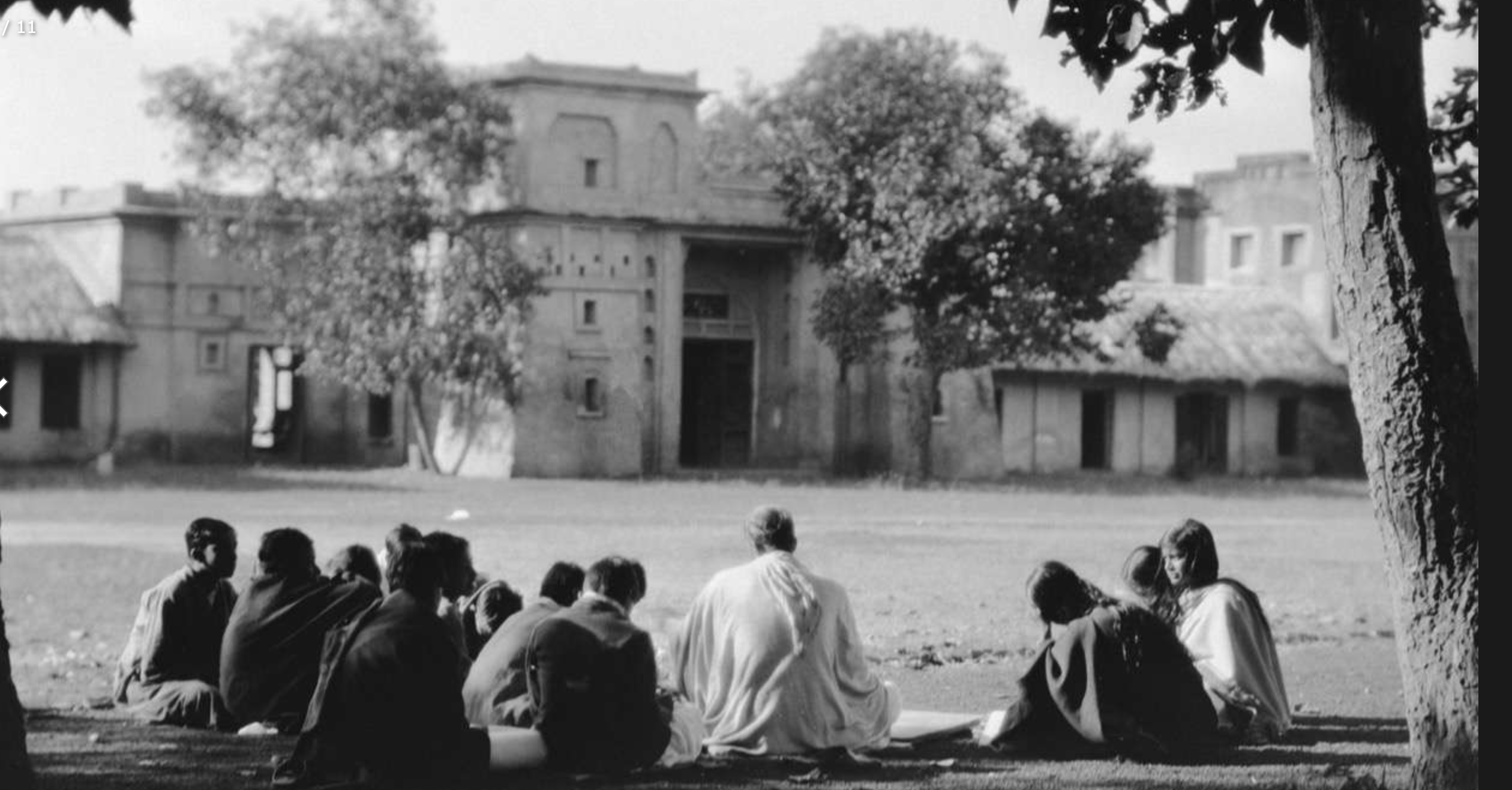
Santiniketan, India. This is where I was born, and attended school barefeet
Thus, my own world view has emerged and evolved with events throughout my life. The fact that I went through my school years withuot footwear, fact there I lived in a place where there were no junk on the street, when plastic was not invented and everything was naturally biodegradable, that my feet had little other than dust when I ame home, fact that we all had to wash our feet before entering – every bit of it influenced my world view as I grew up. I understand my views were markedly different from boys that grew up in cities in India. One could not and did not live the way I did. Nobody completes schools in cities without footwear. Even homelss street beggars have footwear.
But I was not quite poor, per say. Our expenses where way lower. The family income was way lower than in cities. We had no ceiling fan inside home. IN the heat of the summer when sleeping inside was a torture, we slept out in the open in our frant lawn. If it suddenly started raining at night, and Indian monsoon can be torrential, we woudl wake up, take our mattress, pillows and mosquitto net and run indoors. That was all very normal. Your life was in sync with nature. ANd I never got cold, or malaria, or any illness because of living close to nature.
This is how my life’s journey took me from Village India, to Facebook
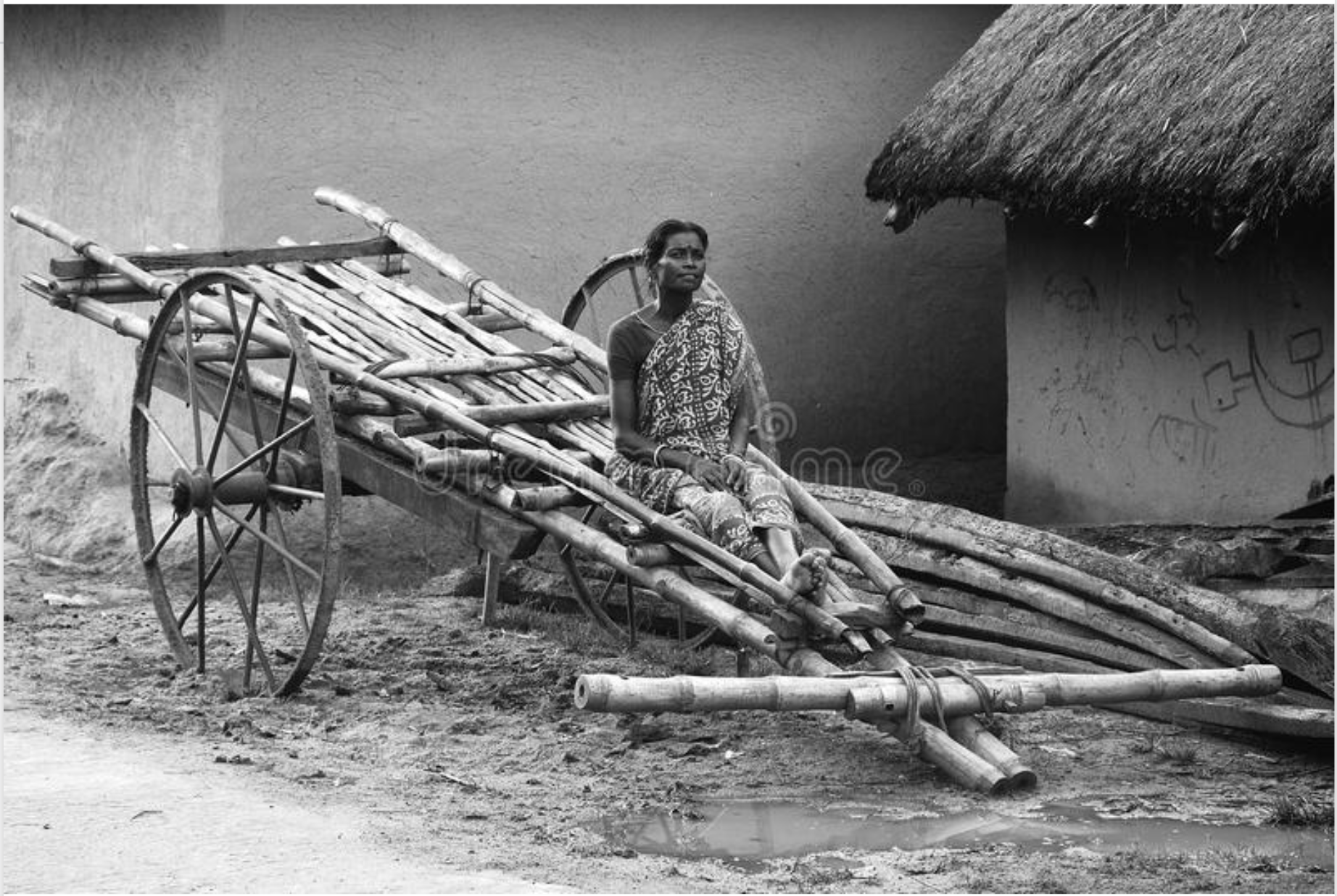
Birbhum district, West Bengal, India – from days that are behind us now, but it was real when I was a kid.
That picture describes my neighbourhood surrrounding our small University townlet of Santiniketan in Bengal, India. Homes where mud walled. Roofs were of straw. Transport was on bullock cartsm made of bamboo, Wheels were at first wooden. But steel rims around fooden wheels made inside the village was entering the fray. And then wholly steel wheels, without tire, was the next step of self sustainability, where the money stayed in the village and did not go to city corporations and factories far away. Sustainability was not just a catch phrase. It was real and omnipresent. That was part of the essence of my childhood. But all that was already changing and at a breakneck speed. I did not realise it then, but my world was being put upside down, little by little, till it comes into multiple crisis at the same time.
I did not know it then, but the agents of such change, the horses of apocalypse, were both the rich and the poor, the left and the right, the corporations and the politicial parties. I did not know it till I was well into my senior years. I thought I knew much of the world when I was a teen and a post teen. But I can now say – I knew only the surface ripples of a very vast and deep system.
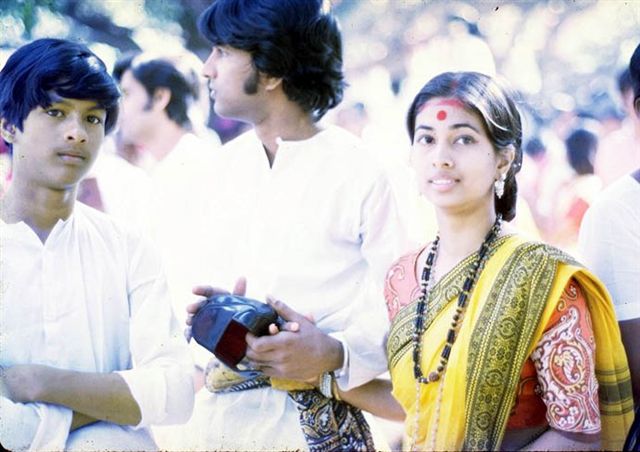
Me in the middle with my siblings. My younger brother at left and my elder sistem, wearing colour, at right. It was at the Santiniketan version of the Holi festival, of Vasanta Utsav, which translates as Spring Festival. Today I am the only one alive.
Fast forward a tumultuous phase of decade after decade of growing up, studying and epansion of our horizon, for good and bad, till I ended up living in Hong Kong just before the turn of the millennia and internet came to the world. Hong Kong was very advanced compared in the early and mid 1990s, to most western regions, and dial up internet came to my home, when Apple computers, Macintoshes, were ahead of the Microsoft PCs to embrace internet and recognise it as what it was soon going to be. Bill Gates caught on soon enough and made a total about turn, covertig the entire PC industry into an internet promoting enterprise.
Soon I was to leave Hong Kong, as the free wheeling and near tax free British Colony was going to be handed over to Communist China and there was fear that the place was going to change and non-chinese people might be kicked out. A huge exodus started out of Hong Kong. Industries, banks and people started moving out. Head hunters from around the world set up offices and channels to catch entrepreneurs, skilled people and industries, to help them resettle in various parts of the west. Kiosks, fairs and shows started coming up in Parks on weekends in Hong Kong, from various such sources. Even the Governments of Canada and USA were organising picnics, shows and taking up Booths in cultural fairs, to attract potential immigrants. It was quite a show. I had not decided to leave initially, but eventually I too got swept in the tide, when a ship owning firm in Miami, Florida, gave me a call and offered me a 7 days free of charge vacation to Miami, if I agree to an interview by the CEO, for a potential job as an executive. No kidding.
And my life changed. However, I was alreay well into the internet, thanks to Hong Kong. I even managed to change my own web page and sight, with a new account from a service provider in Miami, paying for it with my newly acquired credit card linked to a Hong Kong bank, and shifted my web home page there, with a hotlink to my existing Hong Kong based web page. It was all very exciting those days and I was pleased that I could do all that with relative ease, while most of my friends still did not much know what the heck internet was.
Fast forward a few decades and I was then in Canada and first got interest in a host of new social media platforms cropping up everywhere. Facebook was one of them. There were many others and the competition was fierce. Internet connection was by then moved on from telephone dial in, to broadband, in the US where I lived for some years, to Canada, where I migrated to. I have forgotten some of the other platforms, but eventually estabished myself on Facebook, primarily as it was here that I could communicate with the townspeople from my birth place – Santiniketan, West Bengal, India. There it was still dial up, but local system providers where getting busy hooking people up with dial up modems etc. I think broadband lines were still into the future. Those were the heady days.
Today, I have almost nobody in my home town that communicate with me. Many have passed away. Others have drifted away. Some have separated frm me on ideological differences.
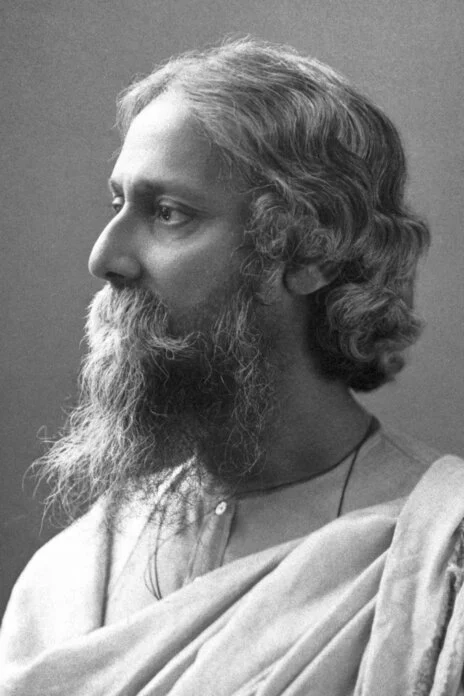
Tagore
You see, internet has been, same time, a great uniter and a great divider. WHen you do not get to hear or read too much from your friends, do you not know too much of his or her world views and ideological bend. So friendship remains stable, though superficial. As internet broadens the communication channels and people spend more time expressing themselves, sometimes fissures come up. For me, life has been a great educator, and I have always had an open and questioning mind, not anchored on any ideology. Nothing was ever written in stone for me. Not religion, not phylosophy, not political affiliation – not nothing. Everything was worth exploring, worth admiring for its good points and criticising for what I considered its bad points. I was perhaps more influenced by my genes, my parents and the only person who greatly influenced my world view – Tagore.
So, I was once a socialist, then a progressive, a liberal, a secularist, then an ism-less humanist, then promoter of small entrepreneurs (I even started a trading company myself in Hong Kong, before realising I was not a businessman at heart, and closed it down after a few years, but not before I had made a few thousand bucks, involved in breaking of ships in western India, through links in Hong Kong, and paid in US dollars). But most of my birth place friends were anchored in stone. Eventually we fell apart.
Things have now come to a head and I have started detesting some of my friends. A young classmate from my school days, who ended up being a professon in a famous Univerity in Delhi, even psoted to me on Facebook that – I was endangerign mankind by refusing to wear a mask and hugging people everywhere and mising with them. I was such a threat to mankind that he was going to report me to the Canadian police, so I would spend my remaining days in jail, and save mankind in the process. No, he was not a mad man. He was a profession in a shiny famous University in the Capital city of India. So much for professors. Suffice it to say, I had by then learned how to block people.
So, my link with the leftist, or left leaning crowd of my own past, drifted apart from me. I myself, through life experiences had leared that some people were too block headed for my taste and childhood friendship was not enough to stay in touch if I was not allowed to speak my mind of items that I thought were ruining the planet, and that neither the left wing, nor the right wing, were honest or path finders.
Eventually, rather late in life, I began to understand how social media like Facebook, Google search and other stuff, where actively engaged in altering public opinion of the entire planet, and have more power to control people, than national governments, and how they were seriously trifling with free flow of information and exploration of the mind.
I have also been aware how some of these corporations have acquired unebelievable power over the people, though mind control, or through stifling opposition, and by having enough money to buy up governments, of not just small countries. There is now a famous joke in America – USA is the best governemnt in the world that money can buy.
And so I engaged in a multiple year effort to get away from, and wean people I like, away from the clutches of Facebook. I have mostly failed in my effort. But that is okay with me. It is not so much the result, but the effort, that makes life worth living, for me. Besides I have largely been a lone ranger in my activism that stretches decades well into my teen years in India. I have rarely ben happy joining any big group, for all sorts of reasons. Mostly I found these group leaders, including political leaders, lacking in ethics and for being in it more for themselves, than for any root social issue.
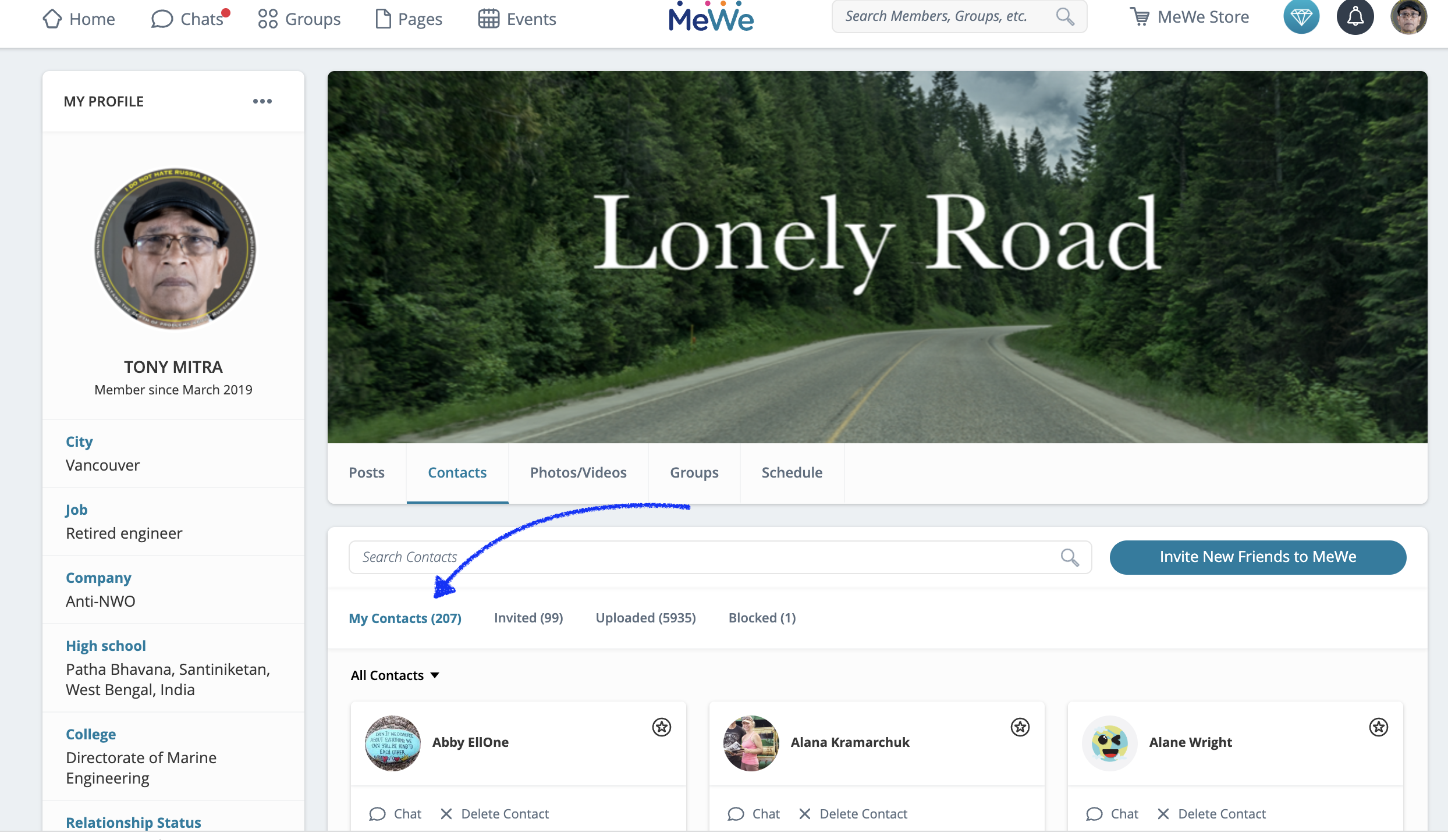
MeWe was another example of my failed efforts. It looks and behaves similar to facebook. In my judgment, opening a second house on MeWe should be least painful for Facebookians. I tried my best to enourage people to move there. Why? Because Facebook seriously and viciously restricts free speech when it comes to certain burnig topics of the world today, and MeWe does not. That alone should be enough for people that are aware of it and are actually engaged day and night criticising Facebook and Zuckerberg, to move there. But I failed in my effort. I now know more about the Artificial Intelligence tools that Zucherberg uses to keep people hooked and unable to leave FB. I admire Zuckerberg for his smartness and detest him for his efforts to guide and shape global public opinion.
But, Zuckerberg is not the guy I have to live with. I am that guy I have to live with. So, my effort on MeWe, as well as others, continue. I have succssfully boycotted Youtube without cancelling my unpaid membership. I have largely transported by recent stuff out of Facebook and on to other channels and platforms. MeWe is one of them. And here is what I have to show for it.
I have only a few hundred friends, who almost never respond or comment on any of my posts, and never generate any conversation that can amount to a conversation.
Do I get that in Facebook ? Not quite. If you have 5,000 friends, over 10,000 followers and another thousand wanting to be my friends – thats a total of 16,000 or so. And then I get less than one meaningful conversation a day on life altering events going on around the world. Sure, lots of folks are busy making small protests nearby on some of these issues. But I can see that virtual protets on the same Facebook that is cleverly engaged in controlling public opinion and acting as a super controlled-Opposition promoter.
But facebook too has been an useful tool for me in my last years. it is a reasonable rough diary, to hone my writing skills. this helps my brain to remain active. Brain is after all the largest and most fuel consuming organ of the body. exercising the brain as as strenuous as running several rounds around my block, but for keeoing differnt parts of my body healthy.
I have always been reasonably healthy. I do not take any jab – not in last 65 years. I never get an infection. My medical bill has been zero for the lat forty or more years. And, thankfully, my brain is still active and my fingers are still nimble enough for me to be baning keyboards to try my writing skills.
Examples of my failed attemps on Facebook to find answers and develop a dialog. I did not know, even three years ago, that Facebook was exactly the wrong platform for this.
So, MeWe and the rest are not necessarily examples of my failure. I have often, and repeatedly, failed in my efforts to engage socially about issues that matter to us socially. But for me, these failed activities were still memorable. These are proofs of an active mind that does not like to give up easily. And I have found a good use for Facebook – a rough diary.
Here is how similar my home page on MeWe looks like my FB page. I think I need to change my profile picture. I instinctively dislike hiding myself behind phony nakes or pictures while socialising. And I like the idea of wrapping text around my picture to express my opinion. I was born opinionated.
The world is constantly inching towards the end of the cliff. The Ukraine war has become toe focal point of a very large set of global issues that is tearing the estabished fabric of global systems apart. A new system is poking its head out of the fractured shell of the egg. It is not at all certain if the transition from the US controlled unipolar hegemonic petrodollar linked world economic system to a yet unidentified multipolar system is going to be peaceful or violent. All the tell tale signs are there.
Click on image to read the document
At one end of the Ukraine imbroglio stands Russia. In the eyes of the western propaganda driven, virtual world citizens of the west – Russia is the greatest bully and a rogue and a crimina invader of an innocent, peace loving Ukraine without any provocation. But in the eyes of those that keep their eyes, ears and minds open, Russia is noen of those things and the US is the greatest instigator and architect of this fame narrative. He has out Sovieted the Soviets of the past and out Propaganda-ed the Soviets too. The lies are so blatact, so omniprent, so unbelievably stupid and stifling, that one has to be a near retard to beleive it all. The lies started a long long time ago and continues to this day. So, for the people awake, Russia is being singled out as the villane on one side of the conflict, with a clear intend to bury it permanently, never to emerge again.
But on the other side, unlike the propaganda narrative, is not Ukraine, which is just a proxy tool and an intended sacrificial lamb, too stupid to understand what is good for it, and controlled by the most corrupt regime on the face of this planet. No, Ukraine is most certainly not on the other end of the conflict. It is the US, the agent provocateur par excellence. Along with the US, is all the nations that hang on to the coat tails of USA. That includes Canada, Australia, New Zealand, and all EU/NATO nations of Europe. And, just for variety, you may also add Japan, the only non-white nation into the mix. That is what Russia is facing single handedly, on false charges.
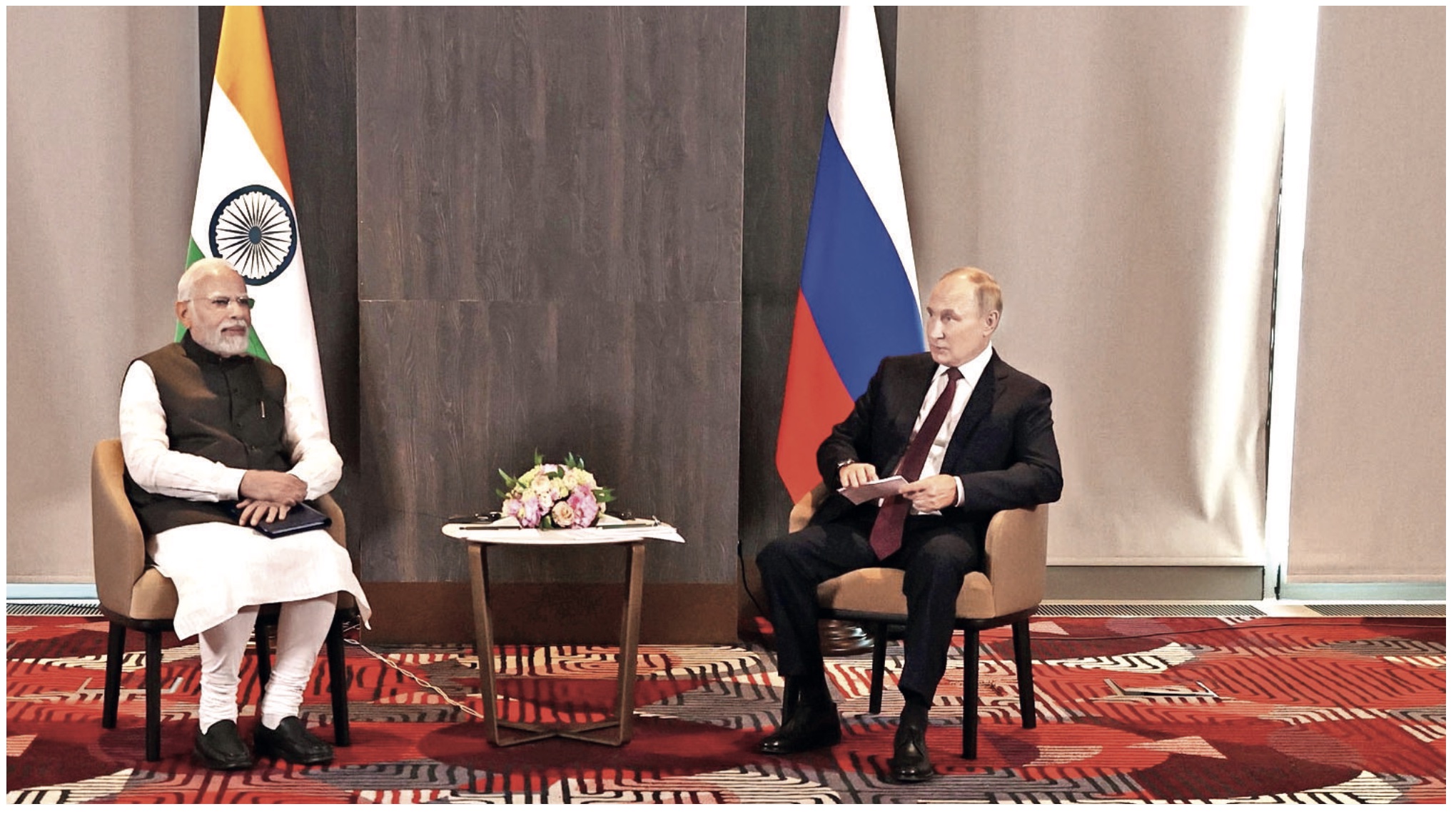
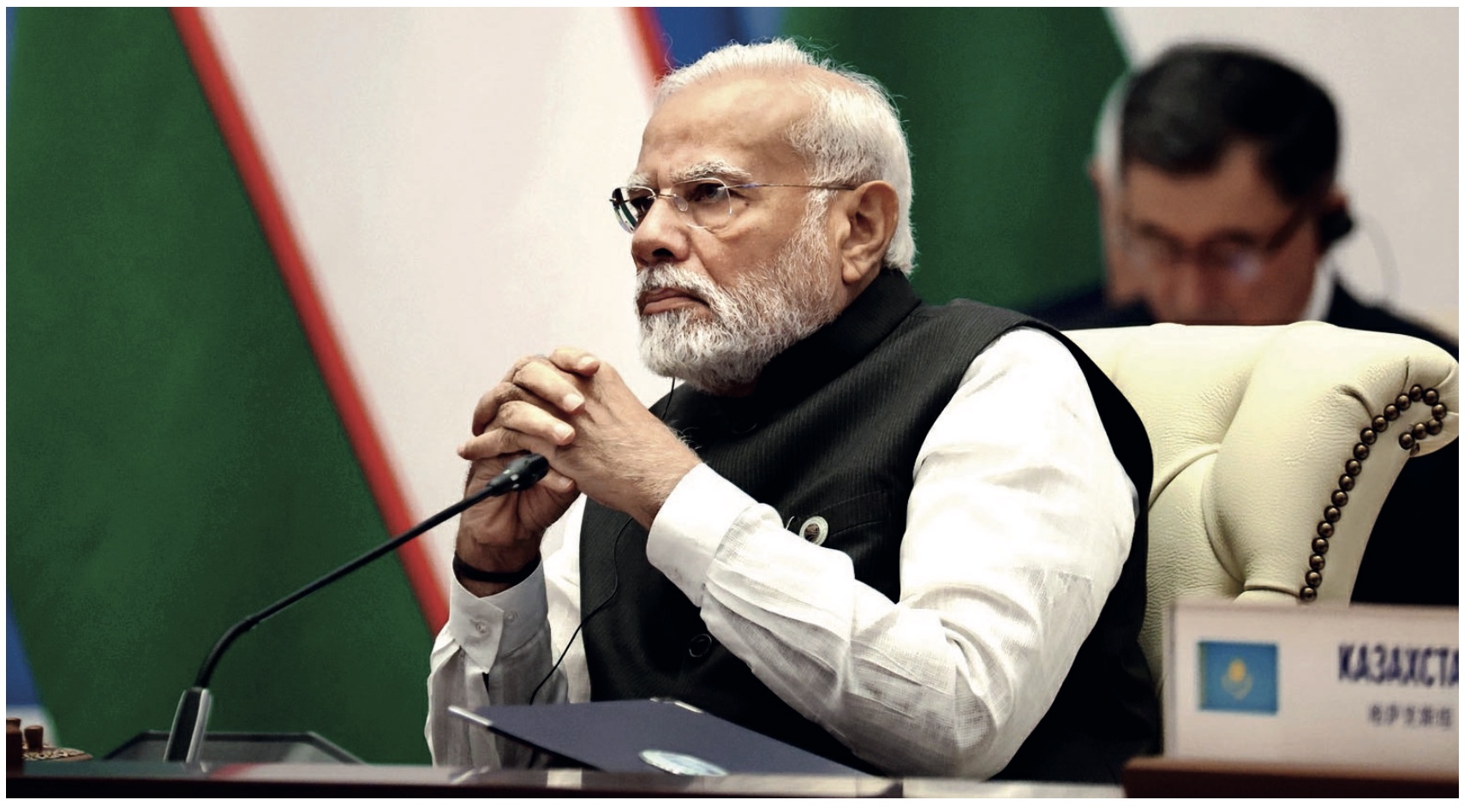
MODI + PUTIN
But then, there is also the non-west nations of the earth, comprising of 85% of the world population. And there is BRICS+. and the Shanghai Cooperation Organisation. There is China, and then there is India. All of them carry significant amount of geopolitical, economic and demographic punch. It is getting increasingly well understood by the world, that there are more than just one block (the west) on earth. And the emerging nations are not particular fond of the west, reembering well the centuries of direct colonisation and subseqquent hidden colonisation ongois ng till today.
India has been playing a tightrope walk for the last one year. Initially they utright refused to sanction Russia and even said how it is dangerous for their national interest to cut trade links with Russia. However, the things turned around rapidly for India.
In jiffy, India managed to secure discounted assurance of Russian Crude oil that the west sanctioned itself out of. Then India proceeded to refine the oil in India, at a rate higher than India’s own consumption. India started filling up its own strategic reserve on one side, and started selling the refined oil on the other side. USA and Europe started importing the refined oil, originally from Russia but repackaged through India. Strangely, this was acceptable to the western sanction regimes. Net result was, India became the worlds third largest oil importer on one side, and a huge refined oil supplier to the west on the other. For reasons such as this, the US seem to have moved on to a coy mode. Its politicians seem not too keen to scold India any more, for continuing to trade with Russia. A few Indian video content creator such as Amit Sengupta started covering such stories on Youtube. One is tempted to say – politics makes strange bedfellows.
So is things going great for Russia? Well, in my mind, there are still unanswered questions. One of them have been why is it so fard to find a Russia loving Russian that is not afraid to speak with me about his views of how his homeland is being targetted, unfairly, by the entire west. I have been looking for such a person for a year now. And although there are over 150 million Russians, I have found only one so far. Everybody else is commenting on the english medium social media, or on podcasts and video, but I cannot find a single Russian to speak on record with.
Who are the good Russians? Who are the bad ones? Why are most of them reluctant to speak on camera ? WHat are they afraid of? Why are they hesitating? My search continues, but I by now have a few suspicions.
Click image to read full document
Author – Tony Mitra
Dentists and Russia
There used to be a joke in my younger years, about dentists in Soviet Union. The joke was – the hardest profession in Soviet Union was that of a dentist – because nobody wants to open his or her mouth. It was a jpke then. But I am beginning to suspect that this is not a joke any more, in present Russia. And there must be a rather strange or sinister reason.
I have been told that Russia is full of internally implanted sppies, Putin-haters and agent provocateurs, apart from an already exising (illegal) Government in exile. The internal colaborators of the US hegemon are at all layers of Government, and the courts or the banks and on social media. The reason is long and complicaed. After the collapse of the Soviet Union, the corrupt Russians came to Boris Yeltsin’s group like flies to a jar of honey.
Boris apparently helped create the class of looters that tried to drain Russian resources dry, and became billionnaires overnight. Yeltsin reaslised the mistake and also got afraid that he was going to end his life being hanged or in jail and that his daughter and son in law too would face the gallows. He tried to right the ship by offering to step down and help elevate the right guy that can steady the floundering Russian ship, but same time spare him and his family. As the story goes, Yestsiin found nobody around him capable enough, except Putin.
To cut a long story, Putin kept his promise, let Yeltsin spend his last years in peace, stopped the national loot and told the instant billionnaires – so far and no further. You can keep your wealth, but the loot stops now.
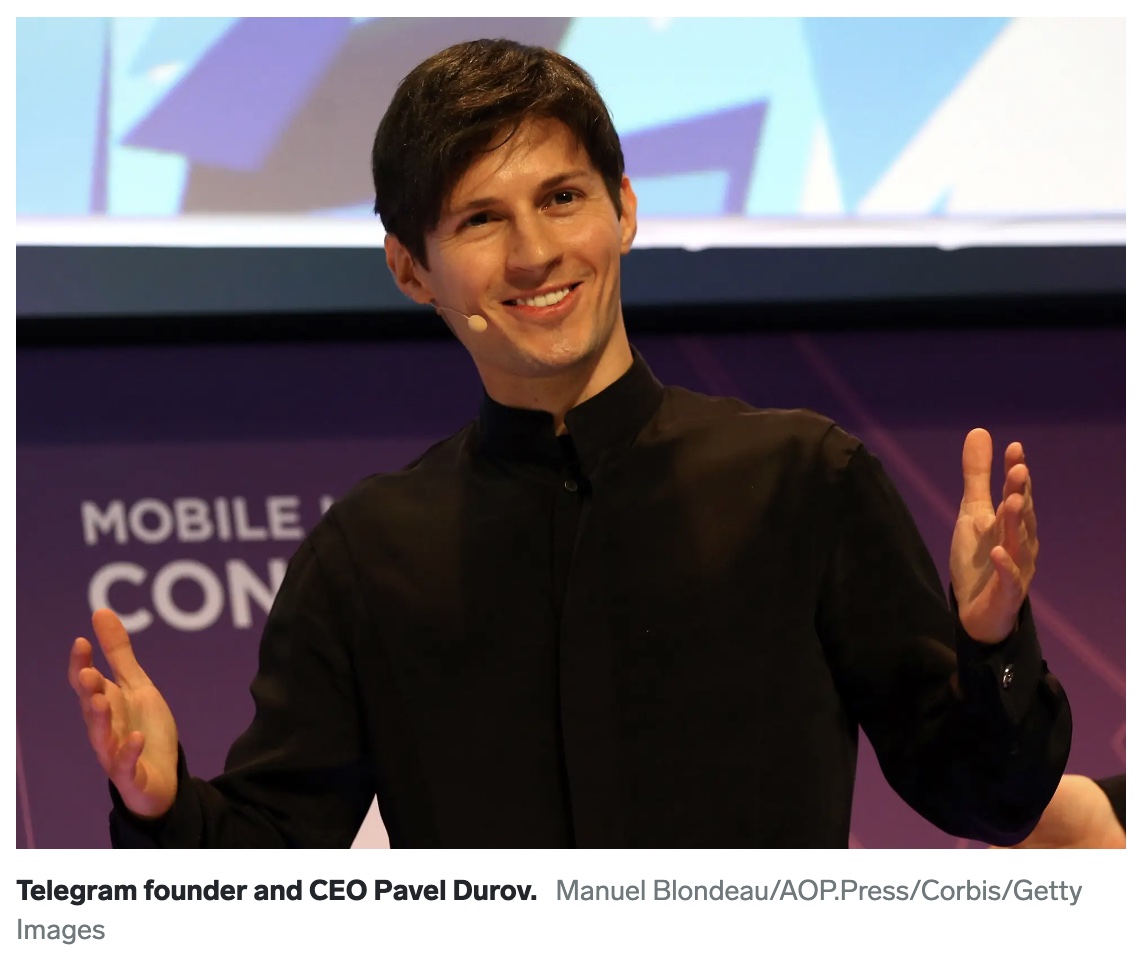
Thus, the crooks remained. Over the years, most of them have now left Russia and taken their cash with them. The owner of Telegram is one such – Pavel Durov, now reportedly a resident of Dubai, is a good example. He is apparently a highly controvertial person, and suspected to be somewhat anti-Putin. Is that because Putin stopped the instant Billionnaires from continuing to loot Russia, or because he refuses to be bought any more?
Some Russians tell me, this man is not straight and he is not exactly a Russia lover. But a lot of activists and such are on his Telegram channel. I myself have found it hard to find an honest Russian to agree to speak with me on record, through huge list of channels on Telegram that are supposedly frequented by Russians. I even had a few Russian speaking friends to post in Russian language to seek a Russia loving Russian to speak freely and without fear to me on record. I have been disappointed in the result initially, because I was not aware of what was gonig on there. No takers of the offer to speak with me so far, except just one Russian woman about six months ago – Ms Irina Muhina. First part of her interview is below. I could not fathom why I am not getting people ready and happy to speak to me. Language was one problem but I did not believe at all that this was the main problem. It took me some time to understand that there are layers of other issues that are likely making some Russians nervous and who to talk to freely. One of the cause of this nervousness, I suspect, is because there is an internal quiet revolution gonig on in Russia, involving house cleaning. Some believe the globalists are slowly filtering out of Russia and taking their assets with him. The west cutting Russia out of the SWIFT system might have triggered an avalanche. I would love to hear more of it from Russia, but do not get much clear talk from Russians. Many are too shy to speak from within Russia. Many more Russians outside of Russia have divided loyalties and confused notions. Many east Europeans carry historical grudge against Russia and many Russians are aware of that and do not wish to speak up. This is a mine field in itself.
That was a few months ago. By now I have spent more than a year looking for honest Russians that do not hate Russia nor Putin and understands the root causes behind the conflict and willing to speak without fear.
The paucity of available Russians, and the rumour that inside Russia, the agent provocateurs are now on the run, and many are slowly exiting Russia. Some congregating around Georgia while others are gravitating towards greener pasteurs such as Canada. I wonder when we are going to have a Stephan Bendera statue here in Canada. Bandera, long dead now, is the celebrated Nazi of Ukraine and Nazis appear to be the new darlings of the west.
I need further confirmation on why I have a hard time finding people in Russia to speak with me. Many agree at first, and then shy away for one reason or another. Some do a partial interview but find excuse to avoid the others, such as sudden fever and illness or too busy to talk face to face or downright hostile and arrogant. I have a sneaky suspecion that these do not love Russia, nor Putin and somehow are playing for the US to destroy Russia, at which time they plan to somehow benefit from it. I also have a sneaky feeling that the good Russians might be aware of what is going on, but do not fully know who is a good guy and who is not, or something. They are therefore more careful and hesitant about exposing themselves, and would rather wait to see if Putin manages to sweep his house clean, or the old Obama plants and left over crooks in Russia manage to bury Putin as well as Russia, and let the US regain its Unipolar global bully status. This is of course, just a hunch.
Facebook is a lot bigger than just a dot – it is a black hole
Connecting the dots in a major puzzle needs most of the dots to be identified and plotted. I have now come to realise that Facebook, along with some others, are dots that just cannot be ignored. When it comes to passing information and shaping public opinion, it is my view that Facebook represents a gigantic dot. This dot is as large as a black hole. Black holes in space are supergiant masses that have so much grvitational pull that even photons, or particles of light that have a miniscule weight but travelling at the speed of light, cannot escape its pull if they pass too close to these guys. What happpens is light too falls into this giant vacuum cleaner and can never excape. No matter how much explosive activity is going on inside that mega-star, no light and no nothing from it can escape its unbelievable gravitational pull, hence the name – Black Hole. Even light that passes near it without getting too close, is bent in its path due to the gravitation. This is one way Einstein to explain how the space as we understand it, is a matrix that is curved by the matter around it etc.
Back to our virtual world – you need to identify and plot the dots on the map before you can connect them. And Facebook, in the current human tapetry, is not just an important dot that is far more important, far larger, than just a dot. it is a virtual black hole.
If you are smart, you may indirectly guess its existence by its absence and how it bends space around it and how its extreme gravitational pull does not allow even particles of visible light, called photon, to escape. That is why it is invisible – even light is unable to escape a black hole. Thus the name – black hole. It is neither a hole, nor black. To be continued ….